
Stablecoins are now handling trillions of dollars in transactions annually, reflecting broad usage across payments, trading, and settlement. Onchain data shows USDT and USDC routinely moving hundreds of billions per month.
A recent report from Chainalysis reveals that between 2024 and 2025, USDT processed an average of about $703 billion per month, peaking at over $1 trillion, with USDC also reaching high monthly volumes. This highlights real money movement across wallets, exchanges, and payment rails.
As stablecoins mature and regulatory clarity improves, a small group of payment companies is proving that crypto payment development can scale. The following seven companies are payments-first builders, focused on merchant checkout, B2B payouts, and stablecoin settlement. Together, they offer a clear blueprint for teams looking to build payment solutions in the crypto space.
Here’s what they can tell us about what actually matters when you’re building payment software with stablecoins.

1) Flutterwave
What they provide: Merchant payments infrastructure, APIs, checkout, remittances, and related rails.
Purpose: Payments infrastructure that connects Africa to the global economy.
Where they operate: Africa, plus expansion into Europe and North America.
Scale datapoint: Flutterwave says it has processed 1B+ transactions totaling $40B+.
Funding and investors (reported): Prior rounds and investors include Visa and Mastercard-related venture arms, plus major growth investors.
Lesson to learn: To be successful, build for real-world constraints first
As of 2025, Flutterwave has processed over one billion transactions, representing more than $40 billion in total payment volume. Within that overall throughput, Flutterwave moved nearly $1 billion in cross-border payments between Africa and East Asia in the first half of 2025 alone.
Operating across African markets means banking rails vary by country. Uptime is uneven. Clearing systems behave differently across borders. Currency controls and compliance requirements shift over time.
The lesson: crypto payments don’t work because blockchains are faster or cheaper in isolation. They work when they’re layered onto systems that already account for how money actually moves. If your product assumes perfect rails, uniform regulations, or ideal network conditions, crypto will expose those assumptions. Building for real-world constraints first is what turns stablecoins into leverage instead of risk.

2) Mural Pay
Where they operate: Focused on the Americas, positioned around global contractor and supplier payments.
What they provide: Stablecoin-based B2B payments workflows including batch payments, recurring payments, tracking, and currency conversion.
Purpose: Streamline business payouts and contractor payroll with stablecoins where useful.
Capability datapoint: Mural states support for 40+ currencies (in the context of contractor payroll and international payments).
Lesson to learn: B2B volume is the fastest path to durable adoption
Mural Pay’s product design reflects a clear understanding of where real payment volume comes from. B2B payments are repetitive by nature.
Payroll runs every pay period. Contractor payouts happen on a schedule. Invoices follow predictable cycles. This repeat behavior creates durable transaction volume and makes payment reliability one of the most important features of payment infrastructure.
Mural Pay is built around these realities, prioritizing batch payments, recurring runs, and workflows that map directly to accounts payable processes.
It’s a practical response to how modern businesses operate. Finance teams are responsible for paying suppliers and contractors wherever they are, not just where banking infrastructure is convenient. Stablecoins fit this environment because they reduce cross-border friction without forcing teams to rethink accounting, reconciliation, or reporting.
For builders, the takeaway is that B2B payments reward infrastructure thinking. Products that align with finance team workflows benefit from natural retention and predictable usage. B2B payment systems earn trust by quietly doing the same thing correctly every time. In crypto payments, that repeatability is what turns experimentation into adoption.

3) Mesh
Where they operate: U.S.-based, positioned as a global crypto payments network.
What they provide: A crypto payments network designed for low-friction conversions and payments routing.
Purpose: Build a “global crypto payments network” and expand payments APIs.
Funding: $82M Series B (March 2025), $120M+ total raised reported.
Lesson to learn: Interoperability is more valuable than ownership
Mesh is built on a simple but often overlooked insight in payments. Users already have money. It lives in wallets, exchanges, and accounts they trust. Forcing users to move funds into a new system before they can pay introduces friction at the exact moment where payments are most likely to fail. The real opportunity is not owning those assets, but connecting them to where merchants want settlement.
By positioning itself as a network layer rather than a destination, Mesh reduces the number of steps between intent and payment.
Expanding APIs and connectivity across wallets and exchanges allows payments to be funded from many sources without requiring users to change behavior. This approach aligns more closely with how payments actually scale. Successful payment systems minimize decision points and avoid unnecessary custody transitions.
The scale of Mesh’s funding reflects confidence in this model. Investors are betting that connectivity infrastructure compounds faster than vertically integrated ownership in payments.
For builders, the lesson is clear. The fastest way to grow a payment product is to reduce fragmentation, not create it. Interoperability increases reach, improves conversion, and allows payment systems to plug into existing financial behavior rather than compete with it.

4) BitPay
Where they operate: Global merchant crypto payments (merchant checkout and spending).
What they provide: Crypto payment processing for merchants plus invoicing and payouts-related capabilities.
Scale datapoint: BitPay reports 600,000+ crypto transactions in 2024.
Additional datapoint: BitPay also publishes ongoing network stats (recent transaction counts) as internal reporting.
Lesson to learn: Reliability beats hype
BitPay’s continued relevance comes from a clear understanding of what merchants actually value. Merchants need systems that work the same way every day, across market cycles, price volatility, and changing narratives.
BitPay’s positioning has remained consistent because the underlying requirement has not changed. Payments must be clear and reliable. They also need to settle predictably and fail gracefully when something goes wrong.
Their processing of more than 600,000 transactions in 2024 reflects persistent usage by businesses that rely on their infrastructure to move real money. At that scale, reliability requires conservative system design, clear operational playbooks, and infrastructure that prioritizes correctness over novelty.
The lesson: In payments, hype does not compound. Reliability does. Each successful transaction reinforces trust, while each failure carries an outsized cost. Products that optimize for uptime, predictability, and long-term stability ultimately win.
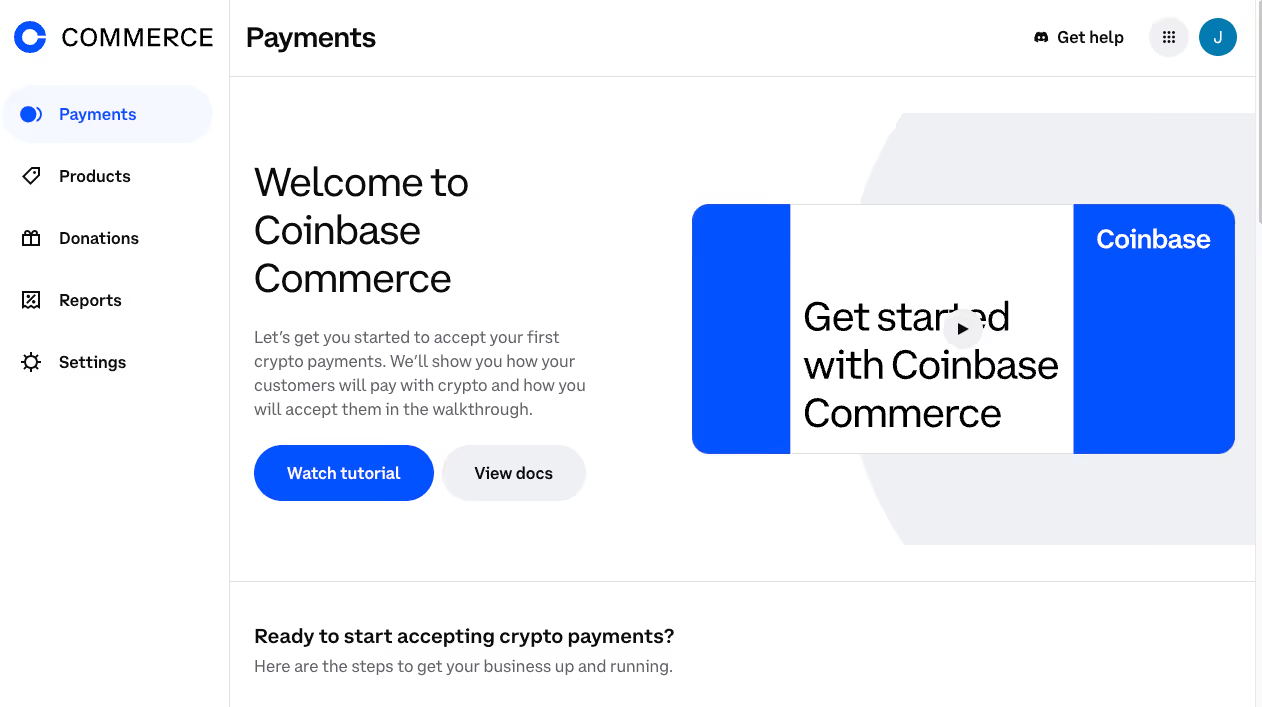
5) Coinbase Commerce
Where they operate: Positioned for global merchant acceptance via onchain payments.
What they provide: Merchant acceptance and settlement via an “Onchain Payment Protocol,” with low fees and instant settlement positioning.
Purpose: Make it easy for merchants to accept crypto payments from around the world.
Structure note: Coinbase Commerce includes documented constraints around what payment types are currently supported in certain flows (reflecting a design choice to optimize merchant experience).
Lesson to learn: Minimizing custody reduces friction
Coinbase Commerce is built on a simple idea: every extra party involved in handling assets adds friction at checkout. When merchants are required to hand over assets, rely on intermediaries, or navigate complex arrangements, onboarding slows, and trust requirements rise.
By enabling merchants to receive funds directly into wallets with instant settlement, Coinbase Commerce removes entire classes of operational and legal complexity from the payment flow.
Instant settlement eliminates uncertainty around when funds are available. Onchain payment flows remove the need for delayed clearing or off-chain reconciliation steps that can break under load.
By framing the product around global acceptance and onchain settlement, Coinbase Commerce aligns with how crypto-native merchants already think about money movement, while still simplifying the experience for buyers.
Builders can learn from this. Reducing how often funds are handled is not just a security decision. It is a product decision. Minimizing handling shortens onboarding, lowers compliance overhead, and reduces failure points. Payment systems that move value directly, with clear and immediate settlement, are easier to integrate, easier to trust, and easier to scale.

6) BVNK
Where they operate: London-based with expansion focus, positioned as a stablecoin payments platform for businesses worldwide.
What they provide: Stablecoin payments infrastructure that connects stablecoin flows to business payments and treasury operations.
Funding: $50M Series B (Dec 2024) led by Haun Ventures (per BVNK and coverage).
Scale datapoint (company-stated): BVNK states it is processing $30B annualized stablecoin payment volume.
Lesson to learn: Compliance and finance workflows are a growth lever
BVNK’s growth illustrates a shift that many crypto payment builders underestimate. Stablecoin payments scale when finance teams can treat them like any other payment rail.
That means being able to reconcile transactions, generate reports, enforce controls, and understand cash positions without inventing new processes. BVNK’s product and messaging consistently center on these realities, highlighting use cases like cross-border B2B payments, merchant settlements, treasury movements, and payroll rather than consumer checkout.
By designing stablecoin payments around finance workflows, BVNK lowers the barrier for enterprise adoption. Finance teams are not evaluating blockchains. They are evaluating whether a system fits into existing accounting, compliance, and risk frameworks.
When stablecoin flows look familiar to the people responsible for oversight, they stop being experimental and start being operational.
For builders, the takeaway is that compliance and reporting are not obstacles to growth. They are prerequisites for it. Payment systems that make finance teams comfortable unlock scale that consumer-focused crypto products rarely reach.

7) Tempo
Where they operate: Built as a payments-focused Layer 1 intended for real-world stablecoin payments, with “design partner” input from major fintech and enterprise players.
What they provide: A purpose-built payments L1 for stablecoins and real-world payments.
Purpose: Payments-optimized chain design, informed by Stripe’s payment experience and Paradigm’s crypto focus.
Structure: Reported as EVM-compatible and designed specifically for stablecoins and payments.
Lesson to learn: Payments infrastructure should be purpose-built
Tempo’s approach reflects a growing recognition among payment builders that general-purpose blockchains often struggle to meet the specific demands of commerce. While Tempo’s mainnet has not yet launched, the project, backed by Stripe and Paradigm, is built around a payments-first perspective where predictable performance, fees, and settlement are treated as foundational rather than optional.
By positioning itself as a chain built specifically for stablecoins and real-world payments, Tempo makes a deliberate architectural tradeoff. Instead of optimizing for maximum flexibility or experimentation, it optimizes for constraints that matter in commerce.
This focus reduces the number of variables builders must reason about when designing payment flows and makes system behavior easier to explain to partners, regulators, and customers. The project has drawn early design interest from partners including Visa, Shopify, Deutsche Bank, OpenAI, Anthropic, and others, reflecting alignment with real-world payment requirements even ahead of its mainnet launch.
The broader lesson is that not every system needs to do everything. When the goal is to move money reliably, purpose-built infrastructure often delivers clearer guarantees, fewer surprises, and a smoother path to scale.
Cross-cutting datapoints that reinforce the broader lessons
- Stablecoins are becoming a mainstream merchant rail: Stripe and Shopify announced USDC acceptance via Stripe for Shopify merchants across 34 countries.
- 24/7 settlement is becoming table stakes: Checkout.com launched stablecoin settlement framed around always-on liquidity and settlement windows beyond banking hours.
- Mainstream PSPs are shipping crypto checkout: PayPal announced “Pay with Crypto” to enable merchants to accept a wide set of cryptocurrencies with conversion into fiat or PYUSD.
Why Turnkey is ideal for payment applications
Turnkey is a wallet infrastructure and key management platform designed for builders developing crypto applications, including payment products.
Payments teams use Turnkey to create wallets, sign transactions, and automate onchain actions through a single API. This allows crypto payments to be embedded directly into existing product, finance, and operational workflows rather than managed as a separate system.
Some features that make Turnkey ideal for payments include:
Security: With Turnkey, private keys are generated, stored, and used inside trusted execution environments (TEEs), hardware-backed enclaves that prevent access from application servers or operators. Transaction signing happens entirely within this hardened environment, enforcing strict boundaries around key access and execution.
Policy: Operating within the same protected boundary, Turnkey’s policy engine enforces transaction rules at signing time. Policies define who can authorize transactions, what actions are allowed, and under which conditions they can occur. Because enforcement happens inside the enclave, out-of-policy transactions are made cryptographically impossible rather than relying on external controls or manual review.
Verifiability: Turnkey’s verifiable infrastructure produces cryptographic evidence showing that sensitive actions, such as wallet creation, policy evaluation, transaction processing, and other high-trust computations, execute exactly as intended inside hardware-isolated secure enclaves. This means developers, users, and third parties can independently confirm that workflows were run with the expected code and configuration, rather than simply assumed to be correct.
For payment teams building stablecoin checkout, payouts, or treasury flows, this architecture provides direct control over how value moves. Signing policies, authorization, and behavior are enforced automatically at execution time, and produce clear audit trails while keeping transaction latency low.
The result is a payment infrastructure that scales with volume and repetition. Keys remain isolated. Policies remain enforceable. Payment flows remain predictable. For teams running recurring, high-frequency transactions, this combination is what makes onchain payments operationally viable.
Turnkey: Secure, verifiable, policy-protected infrastructure for payments.
The seven companies above demonstrate that real-world volume comes from repeatable workflows, predictable settlement, and systems that fit naturally into existing finance and product operations.
Whether the focus is on merchant checkout, B2B payouts, treasury movements, or global settlement, the same patterns emerge. Reliability beats novelty. Interoperability reduces friction. Compliance and controls enable growth rather than slow it down.
As stablecoins move trillions of dollars annually, infrastructure choices increasingly determine whether payment products remain experimental or become operational. At scale, payments require clear ownership of keys, enforceable rules around how value moves, and the ability to prove that systems are behaving as designed.
Turnkey’s wallet infrastructure allows payments teams to create wallets, sign transactions, and automate onchain actions directly within their existing workflows.
For teams building stablecoin checkout, payouts, or treasury flows, this means a payments infrastructure that scales with volume without sacrificing control. Keys stay protected. Policies stay enforceable. Transactions remain predictable. In practice, that combination is what allows crypto payments to move from promising to dependable, and from pilots to production.


Related articles
.png)
Quantum-resistant blockchains: How 9 top chains compare
How nine major blockchains are preparing for quantum threats through protocol roadmaps, approved proposals, and testnet deployments.
.png)
100M+ policies already created on Turnkey: How builders are protecting transactions and why it matters
What builders are encoding in over 100 million policies and what these patterns reveal about the financial systems being built today.


