
On January 6, 2026, Morgan Stanley filed to launch Bitcoin and Solana exchange-traded funds, reflecting a broader shift as traditional financial institutions expand crypto access. This shift has created a need for new software that specifically addresses managing crypto assets and has pushed many fintech companies into designing solutions to meet this challenge.
Crypto introduces entirely new asset classes that do not exist in traditional markets. Tokens, stablecoins, staked assets, tokenized real-world assets (RWAs), onchain credit, and protocol-native yield strategies develop opportunities within decentralize finance that cannot be replicated within traditional finance. These assets behave differently, trade continuously, and settle natively onchain,
Crypto also introduces a structural change in how assets can be controlled. Unlike traditional financial infrastructure, crypto relies on cryptographic ownership rather than account-based custody. This allows fintech platforms to adopt non-custodial architectures where control is enforced through software, keys, and policy rather than through intermediaries.
In non-custodial models, asset management does not need to rely on third-party custodians to approve transactions. But instead, asset control is enforced directly through cryptographic keys and policy-based transaction signing.
Together, these shifts are redefining the role of fintech in asset management and crypto fund management, changing how the companies that serve asset managers and fund managers build, secure, and scale crypto-powered products.
Why smart asset management firms are flocking to crypto
Traditional asset managers are entering crypto for the same reason they have historically adopted new asset classes: client demand and competitive pressure. Institutional investors, family offices, and corporate treasuries increasingly want crypto exposure to be offered alongside other equities.
Underneath it all is a shift in financial infrastructure. Crypto-native rails enable near-instant settlement, global market access, and programmable execution without relying on layers of intermediaries.
For asset managers, this combination is compelling. Crypto is not just another market to trade. It’s a new financial operating system that allows firms and the fintech teams that serve them to build faster, more flexible products while rethinking how assets are managed, secured, and controlled at scale.
The regulatory environment for crypto asset management is moving from uncertainty to clarity
Regulations in the US started setting the stage for crypto asset management in mid-2025 when the GENIUS Act became law, creating a federal framework for payment stablecoins. These clearer rules around issuance and reserves have reduced uncertainty for firms building products around these dollar-backed rails.
At the same time, market structure discussions have also advanced. Proposed legislation like the CLARITY Act reflects growing alignment around how digital assets should be classified and regulated across agencies. While details are still evolving, regulators are working toward defined roles and consistent expectations, giving asset managers greater confidence to build compliant crypto products.
Retirement policy also shifted. In May, the Department of Labor rescinded its 2022 guidance that urged “extreme care” around cryptocurrency in 401(k), signaling a return to a more neutral posture. And later in the year, the White House issued an executive order to expand access to alternative assets, including digital assets, in 401(k) plans, with lawmakers moving to codify the approach.
For traditional asset managers, this is the signal that crypto asset management is moving into a phase where they can participate with confidence and operate within frameworks they already understand.
For fintech builders, the new regulatory environment creates an opportunity to build scalable, programmable financial products and new user experiences on top of compliant, digital-native rails.
Wallet infrastructure as the foundation of managing crypto
Secure crypto asset management depends on a set of core infrastructure components working together, but, importantly, every transaction flows through wallet infrastructure, making its design central to security, compliance, and user experience.
Crypto wallets don’t hold assets directly. Digital assets live onchain. But wallets control access to those assets by signing and approving transactions. To do this, they manage cryptographic keys, long alphanumeric strings generated through mathematical functions that prove ownership and authorize asset movement.
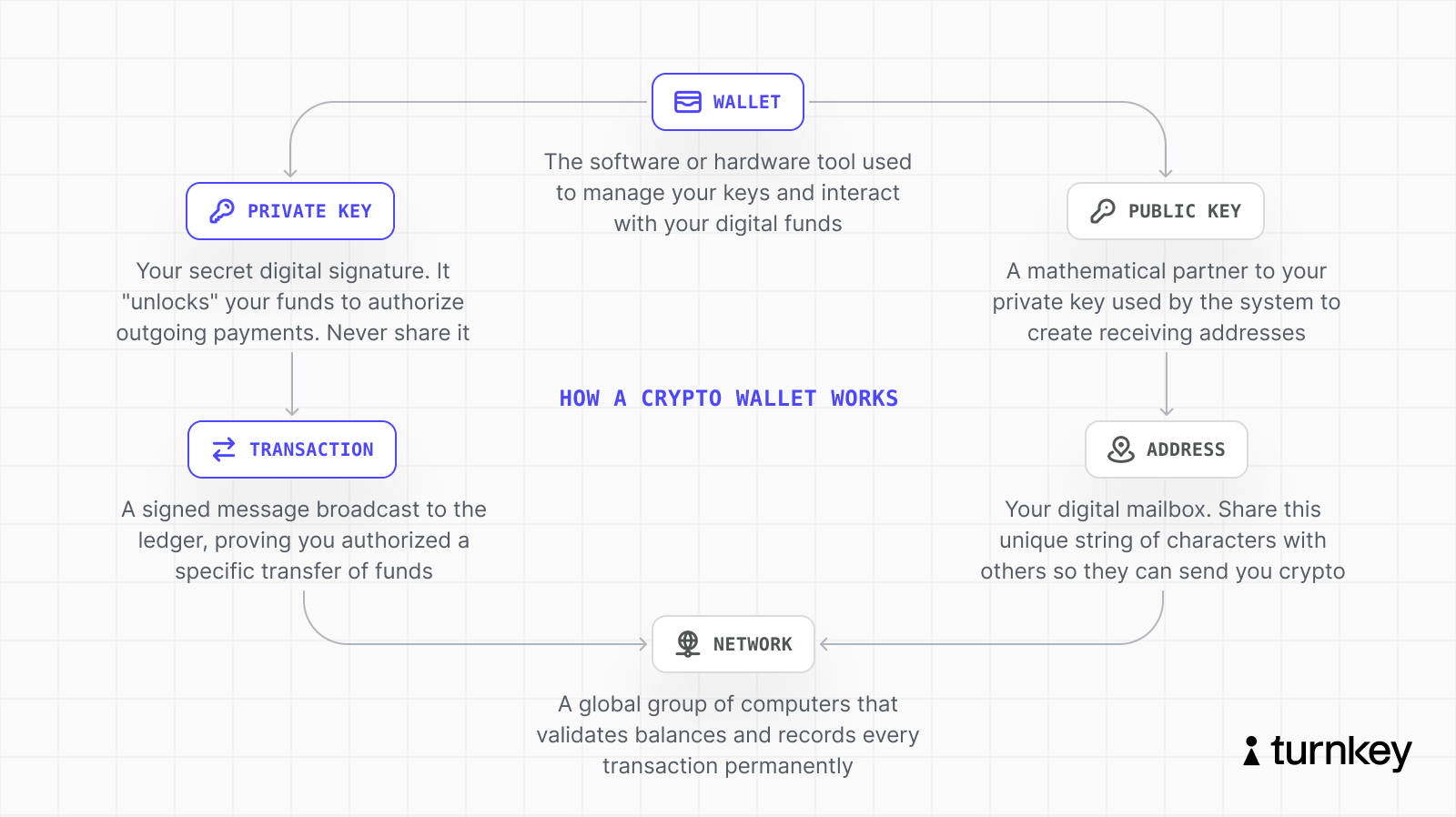
And these keys come in pairs: a public key and a private key that are mathematically linked. The public key serves as an onchain address that others can send assets to. The private key signs transactions and authorizes asset movement, making it the critical component that proves control.
For fintech companies, this raises critical questions that they need to ask when assessing different wallet infrastructure :
- Who controls the private key?
Control of the private key determines who ultimately has authority to move assets, approve transactions, and act on behalf of an account. - How is the private key generated and stored?
Secure generation and storage matter because weak randomness or exposed storage can compromise ownership from the start. - How are transactions authorized and signed?
The signing process defines when and how a key can be used, whether that happens manually, programmatically, or under defined policies. - What happens if the private key is lost or compromised?
Lost keys can mean permanent loss of funds, while compromised keys can enable unauthorized transactions if safeguards are not in place. - How is access audited and restricted over time?
As systems scale, teams need visibility and controls to ensure keys are only used as intended and that misuse can be detected and prevented. - How can regulatory compliance be best met?
Meeting regulatory expectations requires provable controls around access, transaction approval, auditability, and ongoing enforcement rather than after-the-fact reporting.
Control over private keys directly determines control over assets. No central registry or administrator can override transactions in crypto. If a valid signature is produced with a private key, the network treats the transaction as final.
As a result, wallet infrastructure becomes the primary mechanism through which fintech platforms establish trust, enforce policy, and meet regulatory and risk obligations.
Custodial, self-custodial, and non-custodial asset management models
Custodians like Coinbase Custody, Anchorage Digital, BitGo, and Fidelity Digital Assets provide institutional-grade custody services, including secure key storage, transaction processing, insurance coverage, and regulatory-aligned reporting.
While these models can simplify onboarding and compliance, they typically centralize key control and policy enforcement within the custodian’s infrastructure. For asset managers, this means relying on external systems to define how assets can be accessed, moved, and authorized.
Building internal crypto asset management capabilities can offer greater transparency and flexibility. Firms retain direct oversight of workflows, policies, and risk controls, which can be critical as strategies mature. But this comes with greater security risks.
For many asset managers, the decision ultimately hinges on long-term scalability. Third-party custodians can accelerate early deployment but often constrain flexibility and control over asset workflows, while fully self-managed approaches shift significant operational and security risk onto internal teams as strategies grow in scope and complexity.
Because crypto relies on wallets rather than account-based custody, a third model has emerged: non-custody. In this model, investors retain direct control of their assets, while fintech and asset managers enforce controls at the infrastructure level through cryptographic keys, policy-based signing, and deterministic software guarantees.
The following shows the differences between these three models:
Custody optimizes for outsourced control and operational simplicity, self-custody optimizes for direct control but increases responsibility, and non-custodial infrastructure aims to deliver a middle path: keep asset management in-house while enforcing strict, auditable constraints on how assets can be moved within the infrastructure itself.
Why non-custodial models change the economics of crypto asset management
One of the clearest advantages non-custodial infrastructure brings to crypto asset management is a fundamentally different pricing model.
Most institutional crypto custodians price custody as a percentage of assets under custody, with exact rates depending on volume and client profile. For example, industry benchmarks show annual custody fees often range from roughly 0.04% to 0.50% of assets under custody, with setup and transaction fees on top.
Using that market context, a $500 million crypto treasury might pay ~20 bps in custody fees (~$1 million per year) plus operational fees from a traditional custodian. In contrast, non-custodial infrastructure services charge based on activity (wallet creation, signing operations, policy enforcement) rather than asset value. This means ongoing costs are tied to actual usage, not asset size, and can be an order of magnitude lower for similar operational workloads.
Non-custodial platforms also align more naturally with crypto’s native trust model: control through cryptographic keys and policies rather than third-party control.
By shifting from AUM-based custody fees to usage-based infrastructure costs, fintech builders can design products where economics track activity and value creation, not simply asset balances. This improves scalability and reduces friction for products that involve frequent or automated onchain operations.
Turnkey’s non-custodial wallet infrastructure for fintech builders
Turnkey is built for fintechs serving institutions that manage crypto assets at scale, where security, governance, and auditability are as important as speed and flexibility. Its non-custodial architecture allows investors to control keys and signing workflows directly, without exposing private keys to operators, application servers, or brittle internal processes.
Security built for institutional crypto asset management
At the core of Turnkey is enclave-based key management, where keys are generated, stored, and used only inside hardened execution environments. This removes the need to trust internal procedures or manual approvals and replaces them with deterministic, infrastructure-level controls.
Policies for compliance and risk management
Turnkey is purpose-built to support use cases like asset management. With Turnkey’s policy engine, firms can define granular, programmable rules around who can sign, what transactions are allowed, approval thresholds, spending limits, destination allowlists, and time-based or strategy-specific constraints. Policies are enforced automatically at signing, making out-of-policy actions impossible rather than merely discouraged.
Automation designed for high-velocity asset operations
Turnkey also enables safe and secure automation, which is increasingly essential for modern asset management. High-frequency trading, treasury rebalancing, fee management, and onchain operations can be automated without expanding the blast radius of a compromised system. Every automated action is still governed by policy, logged, and attributable, preserving control even as velocity increases.
Verifiability for audits, regulators, and internal risk teams
Turnkey also provides cryptographic proof that wallets were created correctly, that policies were enforced as written, and that signing occurred inside the expected secure environment. This gives asset managers stronger audit trails, clearer evidence for regulators, and higher confidence for internal risk teams compared to traditional self-custody models.
Simplicity without sacrificing control
Fintech developers can design, deploy, and operate sophisticated custody and trading workflows without maintaining bespoke security systems or layered organizational controls. Turnkey abstracts the complexity of key management, security architecture, and policy enforcement behind a clean, developer-friendly interface.
By separating infrastructure from asset ownership, Turnkey helps builders modernize crypto asset management without compromising security or governance. Control is enforced through software guarantees rather than organizational complexity, enabling firms to move faster while remaining aligned with institutional risk and compliance expectations.
Turnkey: Infrastructure for fintech-led crypto asset management
Crypto asset management is quickly becoming unavoidable for traditional finance. Client demand, new asset classes, and digital-native infrastructure are reshaping how assets are managed.
Turnkey helps fintech navigate this shift with non-custodial wallet infrastructure built for institutional needs. By combining security, control, and policy enforcement, Turnkey enables firms to adopt crypto confidently.
As crypto continues to mature, the firms that succeed will be those that treat infrastructure as a strategic advantage. Turnkey provides the foundation to do exactly that.


.png)
.png)