
Over 14,000 Ethereum enthusiasts from more than 130 countries attended Devconnect in Buenos Aires this past November, with nearly half of all attendees coming directly from Argentina.
The event organizers expertly placed Ethereum’s newest conference in a region experiencing some of the fastest crypto adoption in the world. Driven by economic instability and rapid currency devaluation, Latin America recorded a 63 percent year-over-year increase in crypto usage in 2025, nearly matching APAC as a global leader in adoption.

In Argentina, roughly 20 percent of the population owns cryptocurrency, placing the country among those with the highest adoption rates worldwide. For comparison, the global average ownership rate is about 6.9 percent. This underscores how primed the region is for an influx of new capital and innovation.
The conference itself highlighted everything from cross-payment solutions to multi-chain capabilities to advances in ZK-proof systems, reflecting the ecosystem’s rapid evolution.
In this article, we highlight three themes that surfaced repeatedly throughout the week. Speakers consistently returned to the rise of AI-powered agents, the accelerating role of stablecoins in global finance, and the growing demand for secure and verifiable infrastructure across the Ethereum ecosystem.
AI agents: From helpers to financial coordinators
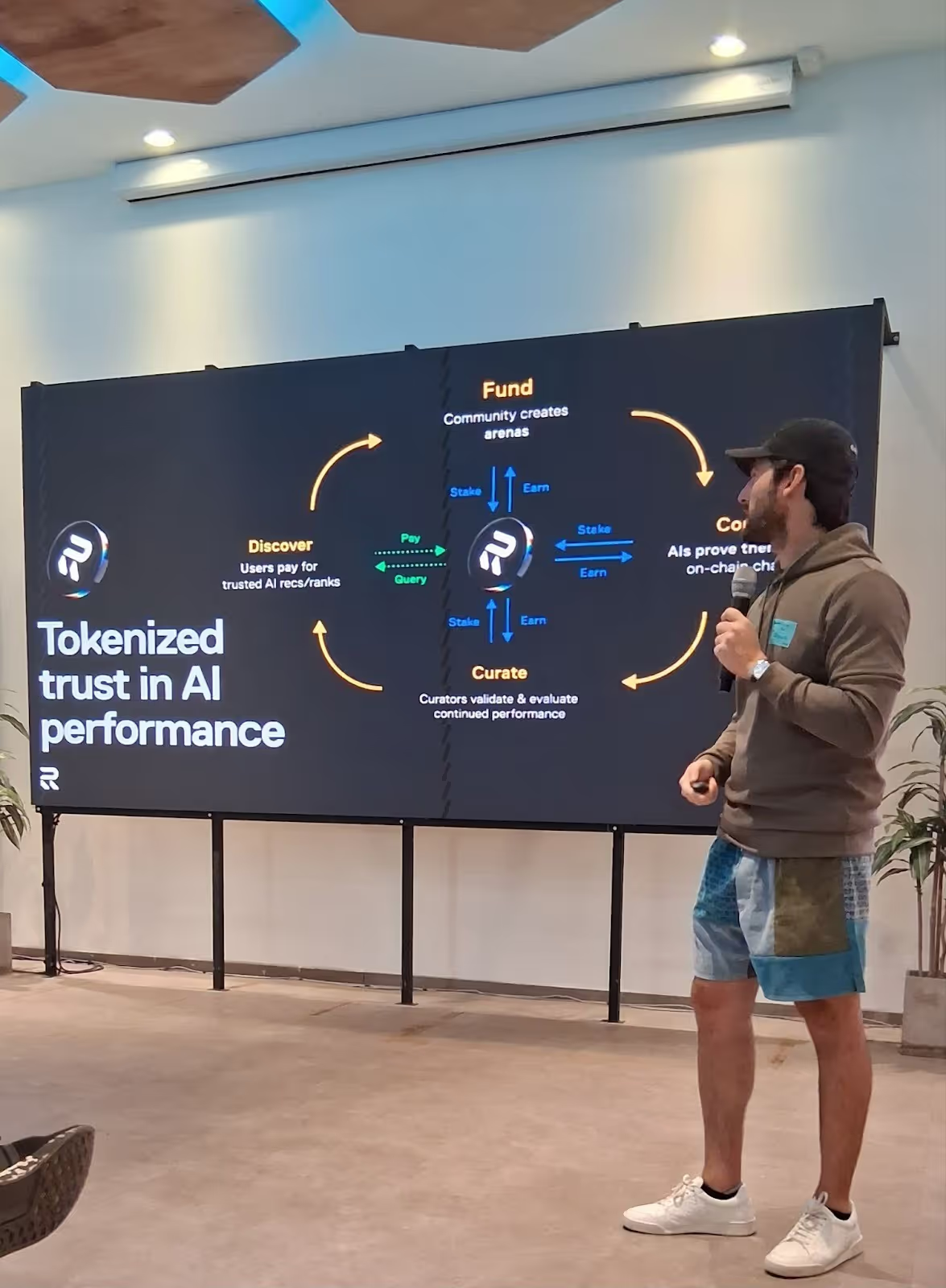
A dominant thread throughout the week was the rapid evolution of AI agents from passive assistants to systems capable of coordinating onchain actions. Speakers described agents operating along a spectrum. Some remain decision support tools, while others show early signs of bounded autonomy across trading, yield strategies, prediction markets, and operational workflows.
Across talks, several ideas kept surfacing:
Agents need structure, not freedom
Builders are increasingly skeptical of giving agents unbounded control. Even experienced users want oversight, auditability, and predictable behavior. Agents are most useful when they operate within well-defined constraints rather than making open-ended financial decisions.
Smart contracts and policies are becoming the control plane
Rather than giving agents private keys, developers are beginning to treat contracts, permissions, roles, and policies as the authority layer. Agents can propose plans, simulate scenarios, and recommend actions, but the system itself enforces what the agent can or cannot execute.
Multi-chain environments amplify risk
As chains, L2s, and app chains proliferate, orchestration becomes more complex. The consensus across sessions was that multi chain agents must rely on verifiable pathways and controlled execution to avoid unpredictable interactions.
Curation matters as much as automation
Many speakers noted that users prefer AI assistance to AI autonomy. Human-in-the-loop design, explainability, and transparent decision paths are key differentiators for agent adoption.
Together, these trends suggest that agentic finance is approaching a new phase. Automation is increasing, but so is the demand for rigorous guardrails, predictable coordination, and verifiable execution. This connects directly to the security themes covered later.
Stablecoins: The financial layer of the ecosystem
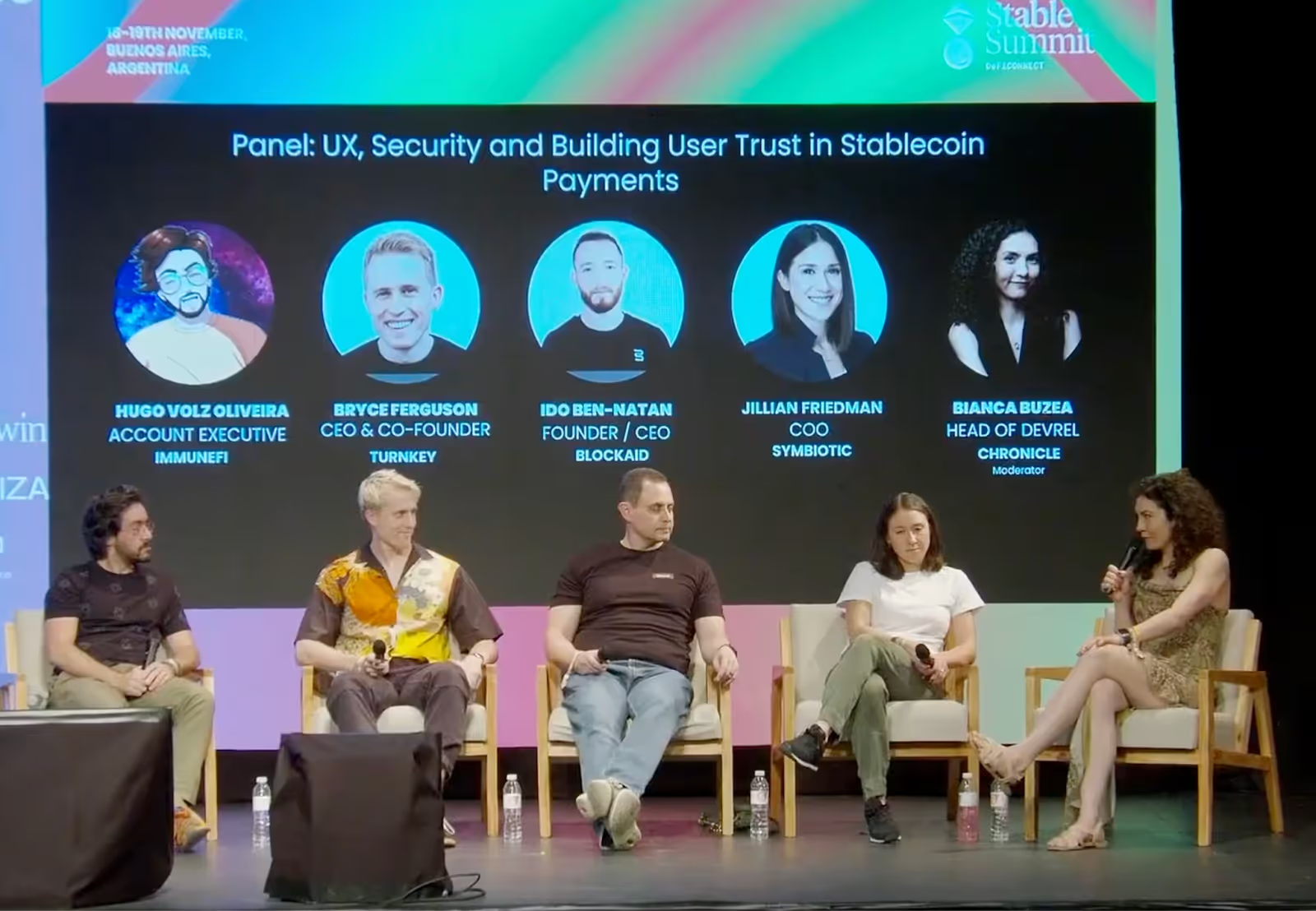
The second recurring theme was the maturation of stablecoins. The conversations throughout the week highlighted how central stablecoins have become to every day financial activity, especially in regions facing currency instability. Stablecoins are no longer treated as speculative assets but as practical tools for transacting, saving, and moving value.
Throughout the week, several stablecoin dynamics were repeatedly highlighted:
Stablecoins already deliver a strong user experience
In a panel focused on stablecoin payments and UX, Bryce Ferguson, CEO and Co-founder of Turnkey, noted that stablecoin experiences have become surprisingly polished. Users can spend with familiar card interfaces, lend into DeFi to earn yield, and bridge assets with low friction. The core challenge ahead is connecting fiat and crypto more seamlessly.
The leap forward will come from what stablecoins uniquely enable
Bryce also argued that the most exciting opportunities are not about replacing credit cards but enabling entirely new experiences. These include real-time money streaming, agent-to-agent commerce, and programmable financial flows that integrate with everyday spending. Stablecoins unlock patterns of movement that traditional payment rails cannot match.
Guardrails will define the next phase of adoption
Panelists across the week emphasized the need for flexible control systems.
- Consumers benefit from simplified UX and abstraction.
- Businesses and institutions need granular controls, policy layers, and the ability to set limits around risk.
In his panel, Bryce emphasized that developers need building blocks that allow them to customize these guardrails in different ways. What is appropriate for a retail user may not be appropriate for a corporate treasury.
Trust will form through hybrid models
Speakers consistently agreed that trust in stablecoins will emerge through a blend of onchain transparency and offchain assurances. Onchain proofs alone are insufficient for all use cases, and purely centralized models fail to offer the openness users expect. A hybrid trust model is the likely future.
Stablecoins are becoming the capital layer of crypto. They represent the interface between traditional finance and autonomous onchain systems. As their usage scales, the need for predictable and provable infrastructure becomes more urgent.
Security and verifiability: The new expectation for modern infra
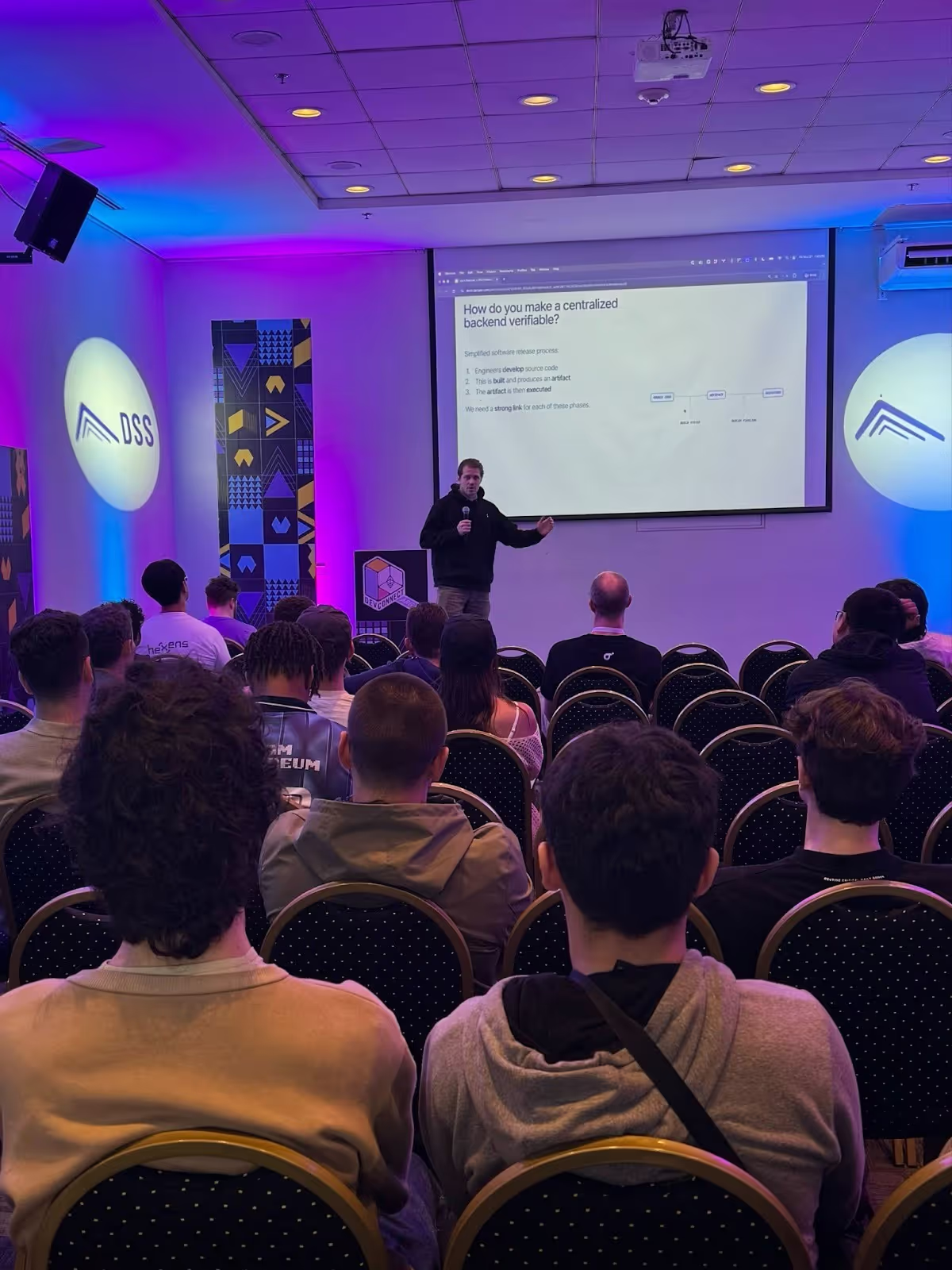
The third major theme was security. Across conversations, demos, and panels, security was treated as the foundation for everything else happening in the ecosystem. The rise of agentic automation and the scale of stablecoin flows make this shift unavoidable.
A central message: Trust must be grounded in proof
Jack Kearney, CTO and Co-founder of Turnkey, captured this shift in his talk Secure if True: Proving Security With TEE Attestations. Jack described verifiability as the ability to prove how a system behaves rather than relying on assumptions. This principle has long been central to crypto protocols, but it is increasingly becoming an expectation for centralized infrastructure as well.
Three foundations Jack outlined in his talk
1. Verifiable execution must prove where and how code runs
Jack explained that trust begins with verifiable execution environments. Remote attestation, particularly through TEEs, provides proof of the identity and constraints of the enclave running the code. This ensures that sensitive operations occur inside a known, attested environment rather than an opaque backend.
2. Reproducible builds must link source code to deployed artifacts
Jack noted that attestation alone does not prove what the binary contains. To establish a verifiable chain of trust, users need to confirm that the deployed artifact was built from the source code they reviewed. Reproducible builds provide this connection by allowing anyone to rebuild the binary and match it exactly, removing reliance on centralized build pipelines.
3. Runtime verification must prove that specific actions actually occurred
Jack emphasized that deployment guarantees are not enough on their own. Systems also need a way to prove that individual operations were executed inside the secure environment. App proofs address this requirement by generating signed evidence for each action as it occurs inside the enclave.
Taken together, these components form a layered approach to verifiability, covering the execution environment, the build process, and the actions performed at runtime.
Turnkey and Anchorage: Trust on tap
During the week, Turnkey and Anchorage Digital co hosted Trust on Tap, an evening gathering for builders and operators focused on secure signing, programmable control, and infrastructure trust. Held at Roa Bar in Buenos Aires, the event brought together clients, prospective partners, and ecosystem teams for conversations on emerging security needs as crypto adoption grows.

The convergence shaping the next cycle
The conversations in Buenos Aires made one point unmistakable. AI agents, stablecoins, and verifiable infrastructure are not separate trends. They are all connected.
AI agents need stablecoins as reliable financial primitives for autonomous value transfer. Stablecoins, in turn, require verifiable infrastructure to operate safely at scale. And verifiability supplies the trust layer that allows automation and programmable money to grow without compromising security.
Together, these forces signal a shift from experimentation to production. Stablecoins are functioning as everyday financial tools. AI agents are moving from theory into practical coordination systems. Verifiable systems are becoming expected rather than optional.
The next cycle will be defined by systems that are agent-driven, stablecoin-powered, and secure by design. And Devconnect 2025 showed that the ecosystem is already moving in that direction.
Turnkey sits at the forefront of this shift, providing the verifiable infrastructure and secure automation rails these emerging systems depend on.
Get started with Turnkey today.


.png)
.png)