.avif)
Solana has been one of crypto's fastest-growing developer ecosystems in DeFi and trading in recent years.
According to Chainspect, Solana's active developer base ranks among the largest of any chain in 2026, and more developers typically means a growing number of applications, integrations, and infrastructure for teams building onchain products.
Solana’s speed, low fees, high throughput, and fast settlement are among the biggest reasons it has become one of the most active chains in DeFi.
But in 2026, Solana's story is bigger than performance. The network has seen a wave of institutional launches, bank-issued stablecoins, and security updates that make it increasingly relevant for fintech and trading teams.
Here are 15 reasons Solana is becoming one of the most popular chains for DeFi and trading in 2026.
Institutional momentum
1. May 2026 became an institutional inflection point for Solana
In a short stretch, several major financial players moved from watching Solana, to building on it:
- Western Union, State Street, and SoFi launched stablecoin or tokenized finance products on Solana.
- Mastercard, Ondo, JPMorgan’s Kinexys, and Ripple completed the first cross-border redemption of a tokenized Treasury between a public blockchain and the banking system.
- US spot Solana ETFs crossed $1 billion in assets under management, reaching about $1.13 billion by month-end. Those ETFs also saw the year’s strongest monthly inflows with zero outflow days.
The Solana conversation is no longer only about whether or not the chain is fast. For fintech builders, the question was whether regulated money movement can run on it. In 2026, more institutions started answering that question by building.
2. Major asset managers brought tokenized funds to Solana
Two of the world's largest asset managers moved their flagship products onto the network:
- State Street launched SWEEP, an onchain liquidity fund built with Galaxy. State Street is a Global Systemically Important Bank, meaning it is one of the world’s largest and most systemically important financial institutions, with roughly $50 trillion in assets under custody. SWEEP is the first tokenized fund from a bank of that scale to go live on Solana.
- Amundi, Europe’s largest asset manager, brought its SAFO money market fund to Solana through Spiko. SAFO is structured as a UCITS-compliant fund, meaning it follows a major European regulatory framework for investment funds. In early July, Spiko became the first European real-world asset issuer to deploy natively on Solana.
All of this connects the Solana network directly to institutional client rosters, not just to crypto-native users.
Issuance and regulated settlement
3. The GENIUS Act created a clearer stablecoin framework for Solana
Regulatory clarity is important for Solana because institutions need more than speed and low fees. They need a legal path for issuance, reserves, disclosures, compliance, and consumer protection.
The GENIUS Act, signed in July 2025, established a federal framework for permitted payment stablecoin issuers. In March 2026, the SEC also classified SOL as a digital commodity, which removed part of the securities overhang that had weighed on institutional participation.
A clearer stablecoin framework makes it easier for banks, fintechs, and payment companies to move from pilots to production. The technical rails are improving, and the regulatory path is becoming clearer.
4. Western Union launched USDPT on Solana
Western Union launched USDPT, a dollar-backed stablecoin on Solana issued by Anchorage Digital Bank, the first federally chartered crypto bank in the United States.
SDPT initially replaced parts of the correspondent-banking workflow that relied on prefunded accounts, and a consumer product, Stable by Western Union, is planned for more than 40 countries later in 2026.
That is a major signal for regulated money movement because Western Union is not a crypto-native startup. It is a global payments company with real distribution, compliance requirements, and settlement needs.
Its launch on Solana shows how stablecoins can become settlement infrastructure for existing financial networks.
5. SoFi launched SoFiUSD on Solana
SoFi launched SoFiUSD on Solana in late May, rolling out to its roughly 15 million-member base, with about $53.7 billion in assets behind it.
SoFi positioned the token as settlement infrastructure for other banks, fintechs, and enterprise platforms, and it is the first stablecoin from a U.S. national bank available directly within a banking app.
Bank-issued and fintech-issued stablecoins are different from speculative tokens. They are designed to move dollars through regulated financial products.
Payments in production
6. Solana repositioned itself as a payments network
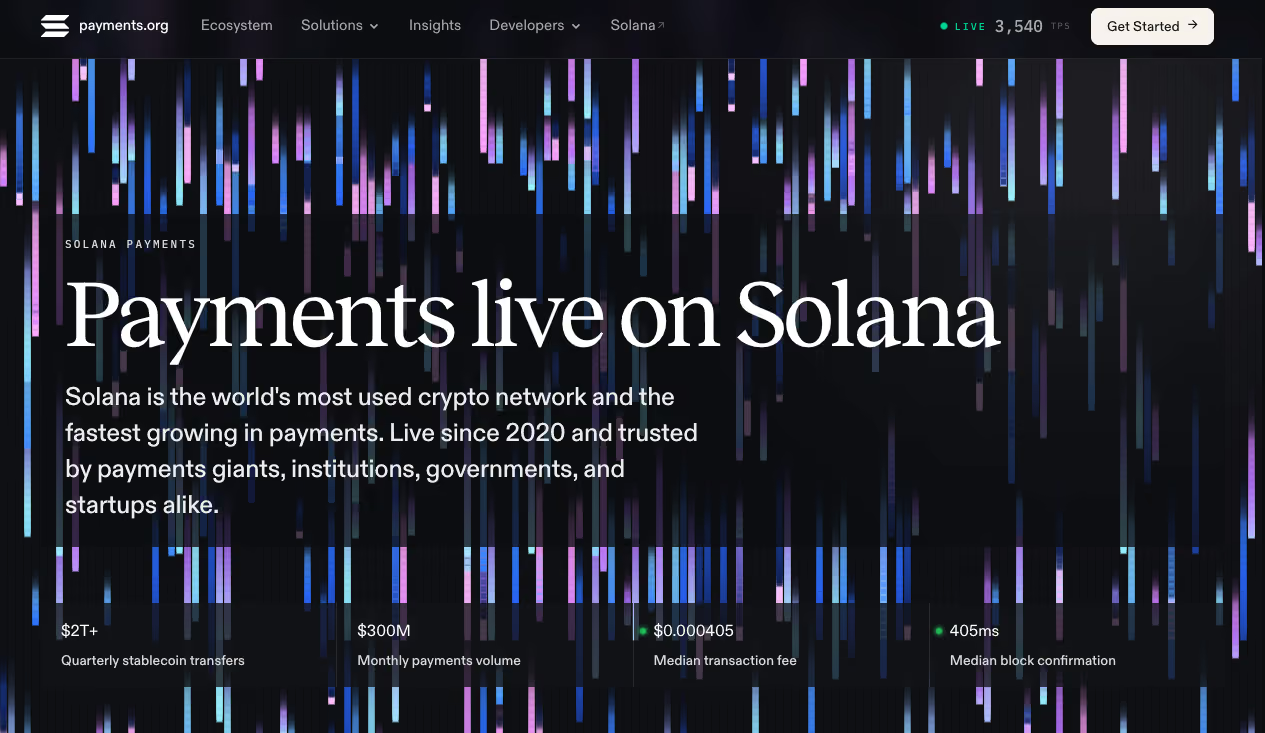
In late February 2026, the ecosystem made its payments focus explicit with the launch of payments.org, a purpose-built hub for Solana payments.
Solana's payments hub reports roughly $2 trillion in quarterly stablecoin transfers and more than $300 million in monthly payments moving across the network.
The launch changes how Solana presents itself. The pitch now leads with production payments infrastructure and named institutional users rather than throughput benchmarks.
For builders, that repositioning lowers how much you have to explain. Shipping a payments product on Solana now means building alongside recognized financial institutions instead of making the case for the chain from scratch.
7. The world's largest payment networks are live on Solana
In May, Mastercard extended stablecoin settlement to Solana as part of its onchain payments strategy, connecting the chain to its global card network. Alongside it, Visa, PayPal, Stripe, Western Union, and Fiserv are running live payment activity on Solana, according to reporting from TheStreet.
Visa's USDC settlement pilot surpassed $3.5 billion in annualized volume, and Worldpay cut processing times by roughly 50% after adopting the Global Dollar Network (USDG) for settlement, with about 57% of USDG issued on Solana, per Messari.
8. Payroll and business payouts are moving onchain
Payments are expanding past consumer spending into how businesses pay people.
In January 2026, Gusto began a pilot to send instant USDC payouts to contractors, targeting the roughly 11% of US small and midsize businesses that hire international workers across a base of more than 400,000 businesses. Traditional wires take three to seven days; Solana settles in seconds.
Stablecoins
9. Solana stablecoin supply reached $16.4B
Stablecoin supply on Solana reached $16.4 billion in May 2026, up from about $5 billion at the end of 2024. The network also processed a record $650 billion in monthly stablecoin volume in February 2026, ahead of both Ethereum and Tron.
That is a major signal because stablecoins are the cash layer of onchain finance. They are used for all kinds of payment use cases.
The more stablecoin supply Solana has, the more useful it becomes as a settlement network for dollar-denominated financial products.
10. Solana led USDC transaction count for seven straight weeks
Solana held the number one position for USDC transaction count for seven consecutive weeks.
In one week, Solana logged 22.7 million USDC transactions, representing 31.8% of all global USDC transactions.
Currently, USDC is one of the most important settlement assets in crypto. High USDC transaction activity suggests Solana is not only holding stablecoins, it’s being used to move them.
11. Cash App and MetaMask Card expanded Solana USDC distribution
Distribution is what turns stablecoin infrastructure into consumer infrastructure.
Cash App, which has more than 50 million users, enabled USDC on Solana in late May 2026. MetaMask Card also lets US users spend Solana USDC anywhere Mastercard is accepted. Around the same time, Meta added Solana-native USDC payouts for creators in Colombia and the Philippines, and Singapore Gulf Bank enabled 24/7 in-bank stablecoin mint and redeem on Solana with zero fees.
More consumer products are making Solana stablecoins available inside familiar financial experiences.That makes it easier for teams to build stablecoin products where Solana runs in the background.
12. Open USD (OUSD), a 140-company stablecoin, is launching natively on Solana from day one
On June 30, 2026, a consortium of more than 140 companies announced Open USD (OUSD), a new dollar-backed stablecoin operated by an independent entity called Open Standard. Solana's official account confirmed that OUSD will launch natively on the network from day one when it goes live later in 2026.
What sets OUSD apart is its economics. Businesses can mint and redeem it with no fees and no volume caps, and nearly all of the yield earned on the reserves flows back to partners rather than to a single issuer. A partner-led board governs the stablecoin instead of one controlling company.
For Solana, day-one native issuance is important. A stablecoin carrying this much distribution, launching on Solana first, reinforces the network's position as a settlement layer for dollar-denominated payments and onchain finance.

Case study
See how Turnkey powers self-custodial Solana wallets for Moonshot
Turnkey's embedded, enclave-backed wallet infrastructure powers Moonshot's mobile app for trading coins on Solana. 1.5M+ users get self-custody through passkey and email login, without seed phrases or browser extensions.
Read the case study →Enterprise developer platform
13. Solana is building enterprise-grade developer tooling
The Solana Foundation launched the Solana Developer Platform on March 24, 2026, a toolkit that lets enterprises build tokenized assets, stablecoins, and payment flows through APIs without needing deep crypto expertise. It bundles more than 20 infrastructure partners across node providers, wallets, compliance, and ramps, with issuance and payments modules live and a trading module planned for later in 2026. Turnkey is among the integrated wallet providers.
Early users include Mastercard, Western Union, and Worldpay.
For builders, this is an important shift, making Solana easier for institutions and fintech teams to build on.
Tokenized assets
14. Solana's RWA ecosystem reached record levels
Solana RWA total value reached a record $3.62 billion in early July 2026, up from about $1.4 billion at the start of the year, across more than 2,000 distinct assets and roughly 292,000 holders. That places Solana third for tokenized assets, behind Ethereum and BNB Chain.
RWA market cap also grew 43% quarter over quarter to $2.01 billion in Q1 2026, led by BlackRock's BUIDL fund doubling to $525.4 million. Institutional issuers kept arriving through the year: Citigroup completed a full trade-finance lifecycle onchain and Goldman Sachs disclosed $108 million in SOL holdings.
Tokenized assets expand what financial products can do onchain. Stablecoins bring dollars onto the network. Tokenized assets bring funds, equities, deposits, commodities, commercial real estate, reinsurance, and other financial instruments.
Security and network maturity
15. Solana is investing in formal verification and incident response
After the April 1 Drift Protocol incident, which cost roughly $270 million, the Solana Foundation launched the STRIDE program.
STRIDE funds 24/7 monitoring for protocols above $10 million in TVL and formal verification for those above $100 million, alongside the Solana Incident Response Network, whose founding members include OtterSec, Neodyme, Squads, and ZeroShadow, for coordinated crisis response.
Institutional DeFi and trading products need stronger assurance around protocol behavior, risk controls, incident response, and application security.
The Drift attack came through social engineering and compromised approvals rather than a smart contract bug, so formal verification alone would not have caught it. As Solana attracts more stablecoin settlement, trading volume, and tokenized assets, operational and human security matter as much as code.
What's next for Solana builders
Alpenglow targets roughly 150ms finality
Solana's Alpenglow consensus overhaul targets roughly 150 millisecond finality, down from about 12.8 seconds today. It was approved in governance with 98.27% support in September 2025, and targets mainnet activation in late 2026 following the Agave 4.1 release in Q3.
It is not yet live on production clusters. It arrives alongside Firedancer, the independent validator client from Jump Crypto that has improved network reliability. For DeFi and trading teams, that could make Solana even more compelling.
Faster finality can improve payment confirmation, market execution, settlement assurance, and real-time application UX. It also reinforces the same core theme: Solana is pushing toward infrastructure that feels closer to modern fintech than traditional crypto settlement.
New AI payment primitives
The Solana Foundation and Google Cloud also launched Pay.sh, a marketplace where AI agents pay per request for Google Cloud APIs, including Gemini and BigQuery, using stablecoins on Solana, and Anchorage also introduced a protocol that decodes complex Solana transactions into plain language for institutional signers.
For builders, 2026 is the year Solana became much harder to ignore.

Case study
Learn how Turnkey secures onchain asset management for Squads on Solana
Turnkey's programmatic, policy-controlled signing powers Squads, the autonomous finance layer on Solana. The protocol secures $10B+ in digital assets and is trusted by 350+ teams across the Solana ecosystem.
Read the case study →Building on Solana with Turnkey
For Solana developers, Turnkey provides the wallet and signing infrastructure needed to turn raw network performance into production-ready applications.
That includes:
- Secure Solana wallet creation. Developers can create embedded Solana wallets for users with familiar login methods like email, social accounts, and passkeys.
- Enclave-backed signing. Solana transactions can be signed inside secure enclaves, keeping private keys isolated from application code, cloud infrastructure, and end-user devices.
- Transaction parsing before signing. Turnkey parses Solana transactions before they are signed, giving developers visibility into key transaction details such as programs, accounts, signers, and instructions.
- Policy-controlled signing. Teams can define policies that control what a wallet is allowed to sign, including rules around programs, accounts, transaction types, approval requirements, and user or organization-level permissions.
- Solana smart contract interface support. Turnkey supports Solana IDLs, which helps developers build more precise policies around program calls and transaction data instead of treating every signature request the same way.
- Gas and transaction abstraction. Developers can sponsor Solana transactions and abstract fees from users, making DeFi, trading, rewards, payments, and stablecoin flows feel more like normal application experiences.
Together, these pieces let teams build production Solana applications without standing up private key management infrastructure themselves.
Turnkey x Solana: Launching the new world of finance
Solana gives developers fast, low-cost rails for DeFi, trading, payments, stablecoins, and tokenized assets. Turnkey is one of the exclusive wallet providers integrated with the Solana Developer Platform that helps make those rails easier to build on securely.
A payment needs a signature. A trade needs a signature. A stablecoin transfer needs a signature. A tokenized asset movement needs a signature. A DeFi interaction needs a signature.
Turnkey helps developers make that signing layer secure, programmable, and policy-controlled, so teams can build on Solana's speed and liquidity without taking on the full burden of wallet infrastructure themselves.
Get started with Turnkey today.