.png)
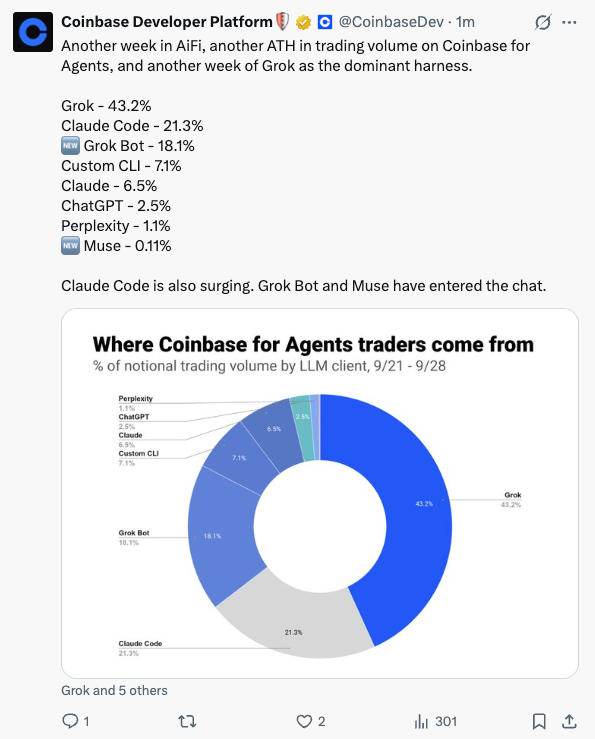
From September 21 to 28, Grok accounted for 43.2% of AI agent trading volume on the Coinbase Developer Platform, with another 18.1% coming through Grok Bot.
Those shares can move significantly week to week, so they are not a durable ranking. But for builders, they offer an early signal of which agentic trading interfaces are getting used in production.
So the more useful question for builders is not simply why Grok leads on Coinbase. It is what each harness requires from your product and what behavior you should expect once you give it access to trade.
There are six worth comparing. Before looking at them, it helps to define what the harness actually controls.
What is a trading harness?
A trading harness is the application layer between the model and the venue where a trade executes.
Think of the stack in three parts. The model decides what to do. The harness translates that decision into an order and sends it through an exchange or wallet connection. The venue underneath executes and settles the trade.
For builders, the harness matters because the same model can behave very differently depending on the application around it. Claude in one client may preview an order and ask for confirmation, while the same model family in another client may refuse the trade or handle the workflow differently.
The model may be similar. The execution environment is not.
What builders should compare
Volume mostly tells you which harnesses are getting used. It does not tell you how well they fit into a product.
For builders, four questions matter more:
- How difficult is it to connect and maintain?
- How reliably does it turn an instruction into a completed trade?
- Can it operate unattended, or does it require a user in the loop?
- What permissions and checks exist before a transaction is committed?
These determine how much infrastructure you need to build around the harness and how much control you retain once an agent starts trading.
A harness can lead in volume because it is fast and easy to connect. That does not necessarily mean it is the easiest to operate at scale, the most reliable for autonomous workflows, or the easiest to constrain.
That is the framework we use to compare the six leading trading harnesses below.
The six trading harnesses featured in the Coinbase data
Grok is the volume leader and the lowest-friction way onto Coinbase, but the model inside it is built more for speed and decisiveness than for deep reasoning.
Strengths:
- Lowest friction to connect. It has had a built-in Coinbase connector since Sept. 9, with no connector URL to paste, and it lives inside X where crypto traders already spend the day.
- Grok 4.7 refused 0% of Artificial Analysis's Cyber Index tasks and posts the lowest hallucination rate of any flagship at 29.3%, so it tends to decline rather than invent.
- Best trading-contest record among the harness vendors, though these are still short-term tests. Grok has performed well across Alpha Arena competitions and currently leads the harness vendors in TradeRank, a paper-trading benchmark.
- Unattended trading through Grok Bot. Routines run on a schedule, or after an event where supported, with the laptop closed, up to 50 per bot.
Weaknesses:
- Weakest reasoning of the top harness models. Grok 4.7 scores 46.4 on general intelligence, below every Claude and GPT flagship, and it knows less, with 47.4% accuracy against Opus 5.5's 66.2%.
- No documented safety step. Coinbase documents no confirmation behavior for Grok, so it can place an order without previewing it first.
- Grok Bot is still in beta (since Aug. 11, 2026), and until the latest week Coinbase folded its volume into Grok's, so its real footprint is only now visible.
- Grok Build trails as a coding agent (56.3 index, below Claude Code and Codex), which matters if you plan to extend it into a custom trader.
Conclusion: Best if you want the fastest, most frictionless path to an order plus unattended routines; weakest if you want a model that reasons deeply or checks with you before it trades.
The command-line setup is the power-user option: model-agnostic, the most reliable at actually getting a trade filled, and the most demanding to stand up.
Strengths:
- Most reliable execution across every model. Coinbase calls the local CLI the most reliable way to execute trades consistently, because its web connector can stall on high-reasoning models that block trades while the local CLI does not.
- Model freedom. Run Codex on GPT, OpenClaw, or a homegrown AgentKit or CDP SDK agent pointed at GPT, Claude, Grok, Gemini, or open-weight models.
- Proven adoption. It was the single largest category in two of the four reported weeks, and it pays for its own data through x402 commands.
Weaknesses:
- Setup cost. You need a CDP API key and a machine to run it on, which rules it out for anyone who wants a chat window and nothing else.
- Momentum is shifting. It slipped to 7.1% in the latest week as Claude Code, charted separately, and Grok Bot surged.
- Unattributed by model. Coinbase never says which models sit inside the bucket, so its share can't be tied to any one model's performance.
Conclusion: Best for builders who want maximum reliability and their choice of model; worst for anyone who wants zero setup.
Claude’s models lead the independent benchmarks, and its web client is the only one Coinbase documents as asking before it trades.
Strengths:
- Leads the independent benchmarks. Claude Opus 5.5 tops general intelligence at 57.6, and Claude Sonnet 5.5 leads tool use on business workflows at 71.3%, both ahead of every Grok and GPT flagship.
- The only documented human-in-the-loop. The web client previews the order and asks before placing it, which is the behavior to reach for if you want a check.
- Strongest coding agent for building your own trader. Claude Code with Sonnet 5.5 tops the Coding Agent Index at 68.4, and Claude Code jumped from 0.35% to 21.3% of volume in the latest week, second only to Grok.
Weaknesses:
- More setup than Grok. The web client connects through a custom connector URL rather than a built-in one.
- Inconsistent across surfaces. Claude Desktop refuses most orders the web client would create, placing them only with explicit authorization, and Coinbase lists no order behavior for Claude Code.
- Most expensive flagships per task, from $5.98 for Opus 5.5 to $7.63 for Fable 5.1, several times ChatGPT's cost.
- Middling trading-contest results. Fable 5.1 sits at +0.17% in the current TradeRank season, and older Claude models finished deep in the red in Alpha Arena, with Sonnet 4.5 at -50.92%.
Conclusion: Best if you want the strongest reasoning and a model that checks with you; weakest on cost, cross-app consistency, and raw trading-contest numbers.
ChatGPT is the decisive, low-cost option, held back by the most setup friction of the major harnesses.
Strengths:
- Cheapest flagship per task. GPT-6.1 Sol runs $0.72 per Intelligence Index task, well under Grok's $2.73 and Claude Opus 5.5's $5.98.
- Decisive execution. It places the order in one turn rather than stopping to ask.
- Competitive models and a cheap coding path. GPT-6 Astra (52.7 intelligence, 68.5% tool use) sits just behind the Claude flagships, and Codex with GPT-6.1 Sol is a capable coding agent at $1.04 per task.
- Respectable trading history. GPT-5.1 was runner-up to Grok in Alpha Arena, and GPT models finished positive in 4 of 9 TradeRank seasons, tied with xAI.
Weaknesses:
- The most setup friction. Developer mode must be switched on before setup, and OpenAI limits agent write actions to Business, Enterprise, and Edu plans.
- Reliability quirks. One Pro model reportedly can't find the connector, and the dedicated trading integration doesn't support x402.
- It shows in the numbers. ChatGPT sat at 2.5% of volume in the latest week, near the bottom of the field.
Conclusion: Best if cost per action and one-shot execution matter most; weakest on setup friction and plan restrictions.
On paper, Perplexity should compete near the top. In practice, it is fading fast and has almost no independent signal behind it.
Strengths:
- Low friction. It has a built-in connector like Grok's and is tied for the fewest steps to connect.
- Unattended operation. Scheduled tasks can run at most once an hour and can use any linked connector.
Weaknesses:
- Collapsing share. It fell from 21.6% to 3.5% in one week, then to 1.1% in the latest, the steepest decline of any harness.
- No benchmark signal. No Perplexity model appears in any trading contest or in the flagship capability comparisons, so there is little independent evidence of how it reasons or trades once connected.
- No documented order behavior from Coinbase.
Conclusion: Best only if you already live in Perplexity's ecosystem; otherwise the least-supported option on this list.
Muse is the newcomer and the speed leader, but it is barely on the board and almost entirely unproven as a trader.
Strengths:
- Fastest top-tier model from any harness vendor. Muse Spark 1.3 outputs 177 tokens per second, ahead of Sonnet 5.5's 139.
- Cheap and low-hallucination for its tier. It runs $1.60 per task with a 32.9% hallucination rate, second-lowest among the flagships.
- Simple setup. You connect it by sharing Coinbase's setup page with Muse.
- Meta's only TradeRank season so far finished positive, at +4.6% in season 8. TradeRank is a benchmark that compares how AI models perform in live trading.
Weaknesses:
- Barely measurable. It only just entered Coinbase's charts, at 0.11% of volume in the latest week.
- Weakest reasoning tier alongside Grok. Muse Spark 1.3 scores 48.1 on general intelligence and 57.9% on tool use, the lowest tool-use score among the flagships.
- No documented order behavior, and its current TradeRank run is slightly negative at -0.17%.
Conclusion: Best for speed and cost experiments; too new and untested to trust with real trading conduct yet.
Comparing these six trading harnesses
The tables below compare the six harnesses on the questions that decide how a trade happens: how few steps it takes to connect, how reliably an instruction becomes a placed order, whether it can run without anybody at the keyboard and what it does before it commits your money.
One thing the harness does not control: what happens when an agent tries to make a bad trade?
Centralized exchanges mostly answer with containment. Robinhood, Binance, and Coinbase isolate agent activity in dedicated accounts or portfolios, block external transfers, and offer controls like asset permissions, spend limits, and approvals.
Those protections matter, but they stop at the account boundary. They limit what an agent can access, not whether a specific order makes sense. Inside the sandbox, a bad agent can still trade away the balance you gave it.
The controls are also defined by the venue. If you need per-order rules, velocity limits, or contract-level restrictions the exchange does not offer, you cannot add them. Confirmation can vary by client too: some harnesses pause before trading, while others execute immediately.
And none of those controls travel across venues. Each exchange has its own account model, connector, and limits, so builders have to inherit and re-create guardrails venue by venue.
With user-owned wallets, the control boundary moves to the signing layer. The harness can propose an order, but policy attached to the wallet decides whether that transaction can be signed at all.
For application builders, that is the difference between inheriting a venue's guardrails and defining your own. You set the rules once and enforce them regardless of which model or harness sits above the wallet.
Turnkey: Guardrails for an economy on autopilot
Turnkey gives each user their own wallet with isolated keys, policies, and activity logs. Keys are generated inside a secure enclave and never leave it. Every signing request is evaluated by a policy engine inside those enclaves before a signature is produced.
If the request violates policy, it is denied before funds can move.
That lets you enforce rules per user, regardless of which harness sits above the wallet. Policies can limit an agent to specific chains, contracts, functions, recipient addresses, and transaction values. Higher-risk transactions can require human approval before signing.
The harness decides what the agent tries to do. Turnkey determines what it is actually allowed to sign.
Get started with Turnkey today.


.png)
.png)