.avif)
A growing demand for wallet services such as crypto wallet app development and Wallet-as-a-Service (WaaS) is accelerating as financial applications increasingly move onchain.
Globally, experts predict the crypto wallet market will grow from about $12.6 billion in 2024 to over $100 billion by 2033, reflecting rapid adoption and investment across wallet technologies.
This trend first appeared in the mid-to-late 2010s, as demand for multi-chain support, early DeFi use cases, and stronger security requirements drove teams to build custom wallets and bespoke crypto wallet development solutions.
At the time, off-the-shelf infrastructure was limited. Tooling was immature, standards were still forming, and most teams needed tightly coupled wallet logic to support fast-moving product requirements. These custom wallet builds gave developers direct control while application needs and technical assumptions were still evolving.
But over time this approach revealed its limits. For the developers and end-users that were to own this wallet infrastructure, the applications left them with ongoing security patching and scaling challenges. Crypto wallet development costs also rose as products expanded beyond their initial scope.
WaaS emerged in the early 2020s in response to these constraints. WaaS platforms expose wallet creation, key management, and transaction signing through APIs, abstracting away the most complex backend infrastructure. This allows developers to integrate secure wallet functionality directly into their applications without building and maintaining the full wallet stack themselves.
This article details the differences between white-label crypto wallet app development and Wallet-as-a-service solutions.
Two paths to shipping a crypto wallet outside of building your own
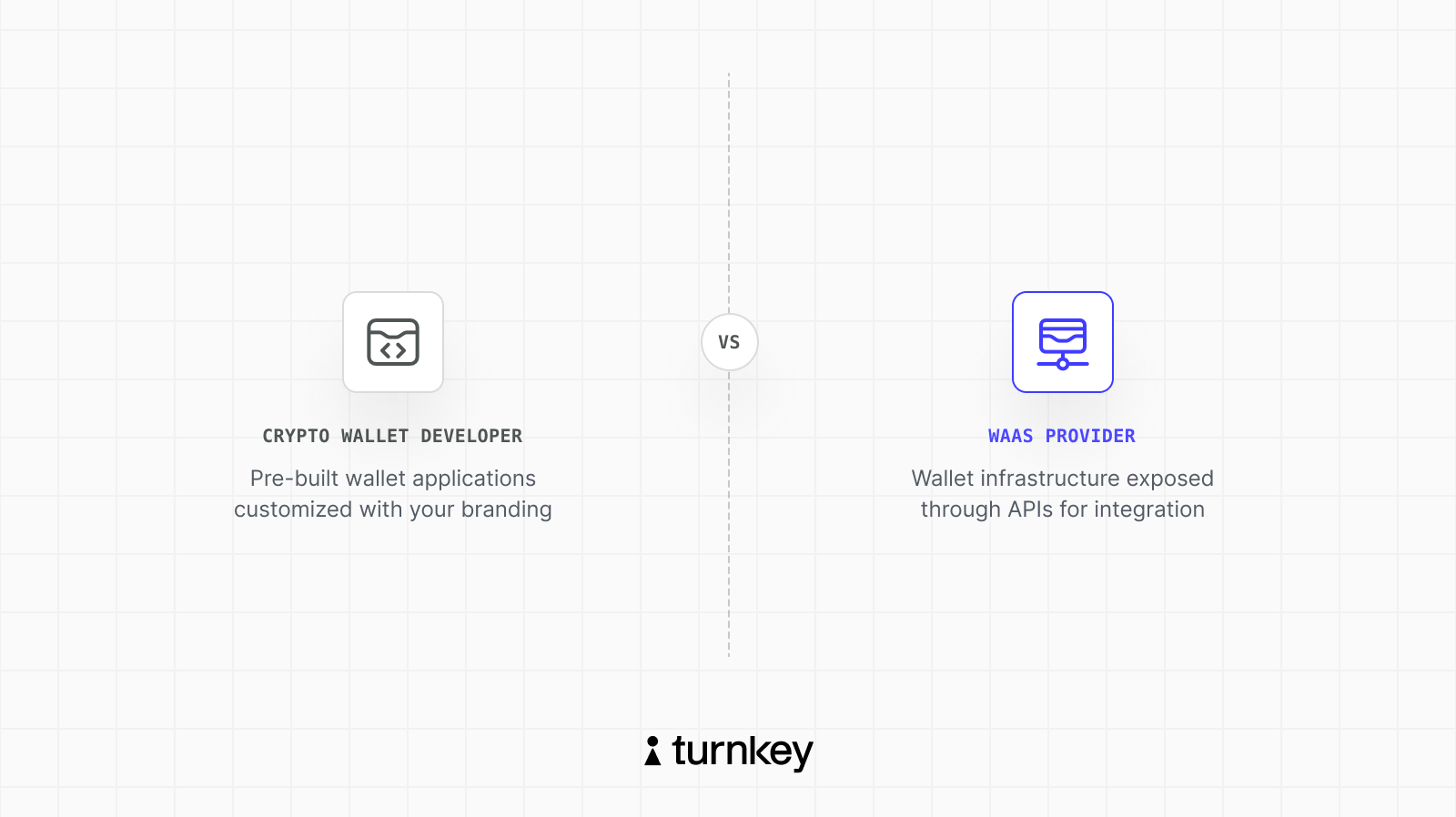
Beyond fully custom builds, most fintech and Web3 teams face an early architectural choice: ship a custom or white label wallet application, or integrate wallet infrastructure directly via a Wallet-as-a-Service platform.
Both approaches can produce a functional wallet experience. The difference lies in how much infrastructure you own, how much control you retain over wallet behavior, and how the system scales as usage grows.
From a developer perspective, this choice is less about UI and more about long-term tradeoffs. Cost structure, security responsibility, upgrade paths, and automation capabilities tend to diverge quickly once a product moves beyond its initial launch.
What crypto wallet app development companies typically offer
A crypto wallet app development company usually delivers a custom or white label crypto wallet development project as a one-time engagement. The output is often a complete wallet application or embedded module that can be branded and deployed.
These projects typically include a user interface, basic key management, and initial chain integrations, while ongoing maintenance may be handled by the vendor under a support agreement or brought in-house once the project is delivered.
Many top white label crypto wallet development companies position themselves as full-service builders. They handle design, backend infrastructure, and deployment to reduce upfront effort for product teams.
The hidden tradeoffs of using a crypto wallet development company
From a developer’s perspective, this model front-loads complexity into the build phase. Over time, however, changes to signing logic, security posture, or supported chains tend to reintroduce that complexity inside the application itself.
Going this route, developers inherit long-term ownership of key management logic, infrastructure hardening, and incident response. These responsibilities persist even if the original vendor is no longer involved.
This is where crypto wallet development cost tends to compound. Maintenance, audits, upgrades, and security work scale with usage, turning a one-time project into ongoing operational overhead.
How WaaS reframes wallet development for developers
Wallet-as-a-Service reframes wallet development by treating it as infrastructure rather than an application. Instead of receiving a finished static wallet, developers interact with wallet functionality through APIs.
Wallet creation, transaction signing, and lifecycle management are integrated directly into product workflows. The wallet adapts to the application, not the other way around.
Rather than purchasing a prebuilt wallet app, teams compose wallet capabilities the same way they consume payments, authentication, or data services. Each function is explicit, programmable, and easy to evolve.
This model aligns better with modern fintech and Web3 development patterns. Developers keep control over product logic while delegating the most security-sensitive components to specialized infrastructure.
Comparing WaaS and crypto wallet development companies
For developers, the difference between Wallet-as-a-Service and traditional crypto wallet development companies shows up quickly once implementation begins. Both approaches can produce a working wallet, but they optimize for very different outcomes.
WaaS treats wallets as infrastructure, while development companies treat wallets as delivered software. That distinction shapes setup time, cost structure, flexibility, control, and long-term risk.
Simplicity of setup compared to a crypto wallet development company
With WaaS, developers skip months of custom wallet app development and move straight to integration. Instead of coordinating a full build cycle, teams connect to existing infrastructure through APIs.
Wallet creation, transaction signing, and policy enforcement are exposed as programmatic interfaces rather than bespoke codebases. This removes the need to design custom key flows, approval logic, and security boundaries from scratch.
As a result, onboarding time drops significantly. Teams avoid lengthy specification reviews, architecture audits, and rework caused by early design assumptions.
The outcome is faster iteration without sacrificing correctness. Developers can focus on product behavior while relying on infrastructure that is already hardened and production-tested.
Cost structure: Project fees vs usage-based infrastructure
Crypto wallet app development companies typically operate on fixed project fees, often followed by ongoing retainers. These costs are front-loaded and largely independent of how the product actually scales.
Once the wallet is delivered, changes tend to trigger additional fees. Expanding scope often means renegotiating contracts rather than simply shipping code.
WaaS platforms shift wallet development cost toward usage-based pricing. Developers pay for wallets, signatures, and activity as they grow.
This aligns infrastructure cost with real usage. Early-stage products stay lean, while scaling products pay proportionally for what they consume.
Flexibility and scalability at the infrastructure level
Custom wallet applications are tightly coupled to early architectural decisions. Key management models, signing flows, and chain support are often embedded deeply into the codebase.
Adding new chains, modifying signing rules, or introducing automation frequently requires refactoring production systems. These changes increase risk as usage grows.
WaaS platforms are designed to scale across chains, wallets, and transaction volume without redesign. Core wallet behavior is abstracted away from application logic.
Developers retain the freedom to evolve product features while the wallet layer remains stable and consistent.
Control without custody: A key developer concern
A common misconception is that WaaS means giving up control. For developers, the opposite is often true.
WaaS provides more precise control over how wallets behave. Rules are explicit, programmable, and enforced at the infrastructure level.
Policy-based signing, programmable approvals, and scoped permissions replace manual processes and brittle application logic. Every action is intentional and constrained by design.
Control is enforced cryptographically rather than operationally. This reduces reliance on internal procedures and human intervention.
Security responsibilities developers should not own alone
Building wallet infrastructure means owning private key isolation, signing correctness, auditability, and breach response. These are not one-time concerns.
They are specialized, ongoing responsibilities that sit outside the core expertise of most application teams. Mistakes tend to surface only after real value is at risk.
WaaS providers focus exclusively on these problems. They invest in hardened execution environments, continuous security improvement, and verifiable workflows.
This shifts systemic risk away from product teams and into infrastructure designed to absorb it.
Why WaaS is increasingly winning with onchain builders
As onchain products mature, development teams are separating product logic from security-critical infrastructure. Wallets are no longer treated as core application features but as foundational components that must be reliable, auditable, and easy to integrate.
In many products, wallets are becoming plumbing rather than differentiation. The competitive advantage shifts to user experience, distribution, and business logic, not custom key management code.
This pattern mirrors what happened in payments, cloud infrastructure, and identity. Teams stopped building these systems in-house once specialized platforms proved more secure and more scalable.
Developers move faster when critical primitives are handled by specialists. WaaS lets teams focus on shipping product while relying on infrastructure designed to hold up under real usage.
Turnkey: The WaaS for modern developers
Turnkey provides Wallet-as-a-Service designed for developers who want control without custody. It treats wallet infrastructure as a programmable system rather than a delivered application.
Wallets are created, secured, and operated entirely through APIs. Developers define how wallets behave, how transactions are authorized, and how access is constrained directly in code.
Keys are generated and used inside isolated execution environments, with policy enforcement applied at signing time. Sensitive material never needs to touch application servers or human-operated systems.
This approach enables automation, auditability, and scale without increasing exposure. Wallet behavior becomes explicit, testable, and repeatable across environments.
Why Turnkey fits fintech and Web3 development workflows
Turnkey integrates cleanly into existing backend services. Wallet operations become part of normal application logic rather than a separate security subsystem.
Developers can model wallet behavior explicitly using policies and APIs instead of relying on opaque implementations or manual processes. Changes to signing rules or permissions do not require rewriting core infrastructure.
The result is wallet infrastructure that feels like modern cloud software. It is composable, predictable, and designed to evolve alongside the product rather than constrain it.
Turnkey: Secure wallet infrastructure for builders
For developers evaluating white label crypto wallet development vs WaaS, the tradeoff is no longer speed versus control. WaaS delivers both.
By separating product logic from security-critical systems, teams reduce long-term risk while maintaining flexibility. Costs scale with usage instead of compounding through maintenance and rework.
As wallet infrastructure becomes more critical to onchain products, leaving it to purpose-built platforms is increasingly the default choice. Developers build the apps. Turnkey handles the infrastructure.



.png)