
Virtuals Protocol and the Ethereum Foundation’s dAI (decentralized AI) team just announced their joint release of ERC-8183, a new proposed standard on Ethereum designed to enable trustless commerce between AI agents.
The proposal introduces a minimal primitive for commerce on Ethereum through smart contracts. Instead of treating payments as simple token transfers, it encodes the lifecycle of a job including escrow, deliverable submission, evaluation, and settlement.
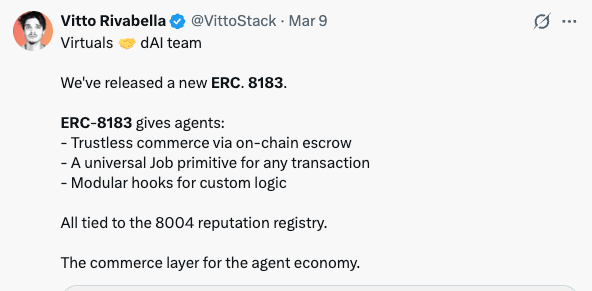
For developers building AI agents that interact economically with other agents, this provides a shared foundation for how those transactions can occur safely and predictably.
Combined with programmable wallet infrastructure like Turnkey, developers can provision agent wallets, enforce policy controls, and allow autonomous systems to interact with these contracts without exposing private keys or relying on brittle custom custody systems.
Why raw token transfers are not enough
Machines can transact instantly, but without structured agreements there is no guarantee either side will fulfill their part of the exchange.
Simply sending stablecoins to an address does not capture what work was agreed to, whether the work was delivered, who verified the outcome, or what should happen if the task fails. Payments alone do not provide enforcement between two parties that may not know or trust each other.
If AI agents are going to be involved in commerce in any real way, they need additional infrastructure. Funds must be held in escrow, deliverables must be submitted in verifiable form, and outcomes must be evaluated and settled deterministically.
To give AI agents this additional infrastructure, ERC-8183 introduces a standardized Job primitive that encodes all of these mechanics directly onchain.
How the ERC-8183 Job primitive works
Per Virtual Protocol’s announcement of the draft standard on X, a minimum commerce object called Job is central to the way ERC-8183 works.
Each Job includes three participants.
- The Client: the party requesting work.
- The Provider: the party performing the work.
- The Evaluator: the party responsible for verifying the result (this may be a human reviewer, an AI system, a multisig group, or a smart contract depending on the type of work).
Each participant is represented simply by a wallet address. This design allows the primitive to work with human wallets, autonomous agents, multisigs, DAOs, or smart contracts acting as evaluators.
The Job follows a clearly defined lifecycle.
- First, the client creates a job and funds it. Payment is held in escrow inside the contract.
- The provider performs the work and submits a deliverable. In many cases this submission contains a hash, reference to offchain data, or proof of computation.
- The evaluator reviews the submission and determines whether the work satisfies the terms of the job.
- If approved, the escrow releases funds to the provider. If rejected, the client receives a refund. If neither party acts before the expiration deadline, the job expires and the client can reclaim the funds.
This lifecycle enables deterministic settlement, allowing machines to coordinate economic activity without relying on centralized intermediaries.
Where this fits in the broader agent stack
Autonomous agent ecosystems require multiple layers of infrastructure to function reliably. They need reputation signals so other agents and systems can evaluate reliability, past performance, and trustworthiness. They also need transaction standards that define how economic activity occurs between participants.
Emerging standards such as ERC-8004 focus on the identity and reputation layer for agents. These systems allow agents to register identities, publish capabilities, and accumulate verifiable performance signals over time.
Commerce activity generated through standards like ERC-8183 can contribute to those reputation systems by producing verifiable records of completed work, evaluations, and outcomes.
Together these pieces begin to form the foundations of an open infrastructure stack for autonomous economic systems. Identity helps agents become discoverable. Reputation helps participants evaluate trust. Commerce standards define how services and payments are structured.
But defining transaction standards is only part of the problem. A commerce standard describes how transactions should occur onchain, but autonomous systems still require secure infrastructure to interact with those contracts.
Agents must control wallets, sign transactions, manage permissions, and execute workflows continuously. Secure wallet infrastructure, policy controls, and reliable signing environments are necessary to allow agents to safely participate in these protocols.
As the agent ecosystem develops, these layers (identity, reputation, commerce standards, and secure execution infrastructure) will work together to enable open networks where autonomous systems can securely discover one another, transact, and coordinate economic activity.
Turnkey support for agent commerce infrastructure
Turnkey provides programmable wallet infrastructure specifically attuned to applications that use AI agents, automated systems, and backend services.
The model allows AI agents to participate in onchain workflows such as payments, trading, settlement, and contract execution while maintaining clear operational controls and infrastructure-level security guarantees.
Secure wallet infrastructure for autonomous agents
Agents participating in ERC-8183 workflows must control wallets capable of interacting with smart contracts continuously. Turnkey wallets are designed for automated systems that need reliable signing infrastructure without exposing sensitive key material.
Keys remain isolated in secure enclaves while transactions are initiated through authenticated APIs. This allows agents to perform economic actions onchain while maintaining strong security guarantees around key custody.
Policy-based controls for autonomous transactions
Turnkey’s policy engine allows organizations to define granular rules for agentic wallets governing how they behave. Policies are enforced at the signing layer, meaning every transaction must pass policy checks before it can be executed.
Teams can restrict which smart contracts can be called, limit which functions are allowed, enforce spending thresholds, or require additional approvals for sensitive actions. This allows agents to operate independently while still enforcing clear operational guardrails.
Smart contract management with role-based controls
Turnkey also provides Smart Contract Management capabilities that help teams govern how wallets interact with critical contracts.
Instead of relying on unrestricted admin keys, developers can define role-based permissions that allow specific contract interactions while restricting others. For example, a wallet might be permitted to call operational functions while upgrade or governance actions remain restricted.
This structure allows applications to automate contract interactions at scale while maintaining strong security controls over sensitive operations.
Delegated access for controlled automation
Turnkey supports delegated access models that allow agents or backend services to perform specific actions without receiving full wallet authority.
An agent can be permitted to fund jobs, submit deliverables, or interact with specific contracts while other operations remain restricted. These permissions allow developers to design systems where agents operate autonomously within clearly defined boundaries.
Infrastructure designed for production agent systems
Autonomous agents often need to operate continuously and execute large volumes of transactions. Turnkey provides infrastructure built for these environments, combining programmable wallets, policy enforcement, delegated permissions, and contract management controls.
Together, these capabilities allow developers to build agent systems that interact with ERC-8183 commerce contracts safely while maintaining operational security and governance.
Turnkey, ERC-8183, and ERC-8004: the emerging infrastructure stack for autonomous commerce
AI agents are beginning to act as economic participants within blockchain networks. Enabling these systems requires new infrastructure that supports machine-to-machine commerce.
ERC-8183 introduces a primitive designed to structure these interactions on Ethereum. By defining how tasks, payments, and evaluation interact within a single transaction flow, it provides a foundation for agent-to-agent commerce.
However, standards alone do not enable production systems. Autonomous agents also require secure wallet infrastructure, policy controls, and reliable signing environments.
Together, emerging standards like ERC-8183 and infrastructure platforms like Turnkey provide the building blocks for autonomous economic systems operating onchain.
Get started with Turnkey today.