.png)
The best blockchains for AI agents are not necessarily the ones that best fit human transaction needs.
Both humans and AI require things like fast, inexpensive settlement, deep liquidity, and reliable transaction execution. But as delegated actors, agents also have requirements unique to their own use case.
For example, chains like Ethereum and NEAR offer useful identity and permissioning primitives. These features make agents easier to identify, audit, and constrain.
This article looks at the chains positioning themselves for the agentic economy: which ecosystems are adding support specifically for agentic finance, what that support looks like, and how these features can give builders greater transaction visibility, stronger security, and more verifiable infrastructure.
Why builders need to pay attention to the agentic economy
Agentic finance is still early, but adoption is becoming measurable.
In April 2026, Coinbase reported that the x402 machine-payment ecosystem had reached more than 165 million transactions, approximately $50 million in volume, and 480,000 transacting agents.
The strongest growth is concentrated where financial decisions can be translated into clear, repeatable actions.
- Payments and commerce. Moving beyond helping users compare prices toward completing purchases on their behalf, agents are now buying, settling, and routing value without manual approval.
- Trading and portfolio management. Agents can monitor markets, execute trades, rebalance portfolios, and respond to predefined conditions around the clock. Onchain markets are particularly well suited to this because agents interact directly with exchanges through programmable wallets.
- DeFi and treasury operations. Across DeFi and treasury operations, agents are emerging as powerful economic engines by monitoring lending positions, moving funds between protocols, managing liquidity, and putting idle assets to work.
- Agent-to-agent payments. As multi-agent systems become more common, agents need to pay each other directly for data, compute, APIs, and services. These machine-to-machine payments are often global and high-frequency, with transaction sizes that don't fit traditional payment rails.
For builders, this shift makes the underlying wallet and chain infrastructure increasingly important. Agentic systems must support continuous operation, machine-speed transactions, and interactions across protocols and services. Infrastructure choices will ultimately determine what agents can do, where they can operate, and how reliably they can transact.
What it means that a chain is “positioned for the agentic economy”
An agent-ready chain should perform well across four practical dimensions:
- Settlement and speed. Can the network clear frequent, low-value transactions without fees consuming the payment?
- Agent identity and permissions. Can developers identify an agent and constrain what it is allowed to do?
- Stablecoin support. Can agents transact in a predictable unit of account rather than carry volatile assets for every workflow?
- Verifiable control. Can a business enforce spending caps, destination allowlists, contract restrictions, approvals, and emergency revocation before a signature is produced?
These controls matter because an agent that can transact without supervision must also be prevented from exceeding its mandate. For a deeper treatment of that risk model, see how to protect critical assets in agentic systems.
1. Ethereum: the standards and settlement layer
Ethereum remains the reference layer for agent identity, reputation, commerce, and settlement.
ERC-8004 proposes onchain identity, reputation, and validation registries that let agents discover and evaluate one another without a pre-existing trust relationship. That is an essential primitive for an open agent economy: a machine needs a way to determine who it is dealing with before it delegates work or sends payment.
Turnkey’s agent identity infrastructure for ERC-8004 adds protected signing and policy controls for registering and operating those identities.
The proposed ERC-8183 commerce standard adds a minimal “Job” primitive. A client can fund work, a provider can submit a deliverable, and an evaluator can approve or reject the outcome before escrow settles.
Combined with ERC-8004, it sketches a fuller machine-commerce stack: identity answers who an agent is; reputation helps counterparties assess it; and the job contract structures how work and payment move between them.
Ethereum’s advantage is maturity. It has deep stablecoin liquidity, widely used smart-contract infrastructure, and the standards process other ecosystems often reference. Even when day-to-day agent execution happens on an L2 or another high-performance network, Ethereum can remain the identity, reputation, escrow, or high-value settlement layer.
2. Base: the agentic-payments hub
If Ethereum is where many agent standards are defined, Base is where a large share of agentic payments are settling.
Coinbase’s x402 protocol is an internet-native payment flow. A service can return payment requirements, an agent can authorize an onchain stablecoin transfer, and the request can continue after settlement, all without a human filling in a checkout form.
Base’s combination of low fees, fast execution, USDC liquidity, EVM compatibility, and Coinbase distribution is difficult to replicate. It lets developers use familiar Ethereum tooling while making sub-dollar API payments economically plausible.
The caveat is that transaction counts alone do not prove durable agent commerce. Incentives, testing, and speculative activity can inflate early usage. Builders should evaluate the quality of demand – repeat buyers, useful services, payment volume, and retention – not only raw transaction totals.
Turnkey integrates directly into this flow. Its agentic payments documentation shows how a Turnkey-backed Viem account can replace the raw private key normally used by an x402 client. This enables safer automation by replacing embedded keys with policy-controlled signing, spending limits, and auditable permissions.
Base is also among the networks with native EVM gas sponsorship, so an agent can pay in USDC without first acquiring ETH for transaction fees.
3. Solana: the high-throughput agent venue
Solana is well suited to agents that act often: trading systems that continuously rebalance, services that stream small payments, and consumer applications that embed an agent behind a fast interface.
The ecosystem now includes agent identity, authentication, payments, governance, and data-access tools. This is more than payment plumbing. Applications such as Donut use embedded wallets to let agents research and execute at network speed.
Solana’s tradeoff is operational complexity. Transactions rely on recent blockhashes, compute budgets must be set correctly, priority fees can change, and creating accounts may require rent funding. Fast execution does not help if an agent’s transactions expire or fail under load.
Turnkey addresses that layer directly. In March 2026, it joined the Solana Developer Platform as a wallet infrastructure partner.
Turnkey’s Solana Policy Engine can restrict amounts, recipients, accounts, and program interactions before signing. Turnkey also provides Solana transaction management and gas sponsorship, including blockhash fetching, compute simulation, dynamic priority fees, broadcasting, confirmation tracking, and optional gas and rent sponsorship.
For agents that generate frequent onchain actions, that combination, network performance plus reliable, policy-controlled execution, is a strong production fit.
4. Sui: an architecture for concurrent agents
Sui’s object-centric data model maps naturally to multi-agent systems, allowing for parallel execution. If dozens or hundreds of agents manage separate portfolios, tasks, or data objects, their actions should not block one another unless they are trying to modify the same state.
Sui supplied a striking demonstration of its capabilities on July 4, 2026, when AI agents and users generated a peak of 6,086,766 transactions per second across games, payments, and chat. The experiment demonstrated how Sui can support high-frequency offchain interaction with verifiable onchain settlement.
Sui is also assembling a broader stack around the layers that are important for agents.
- Walrus provides decentralized storage for datasets, model artifacts, logs, and long-term agent memory.
- Seal links encrypted-data access to programmable onchain conditions.
- SuiNS can provide names and identity surfaces, while DeepBook supplies an onchain central limit order book.
Together, those tools support agents that need memory, permissions, identity, and liquidity, not just transaction throughput.
Turnkey’s Sui network support includes Sui address derivation and Ed25519 transaction signing, allowing each agent to receive a distinct wallet without exposing private keys.
5. Tempo: a payments-first L1 for machines
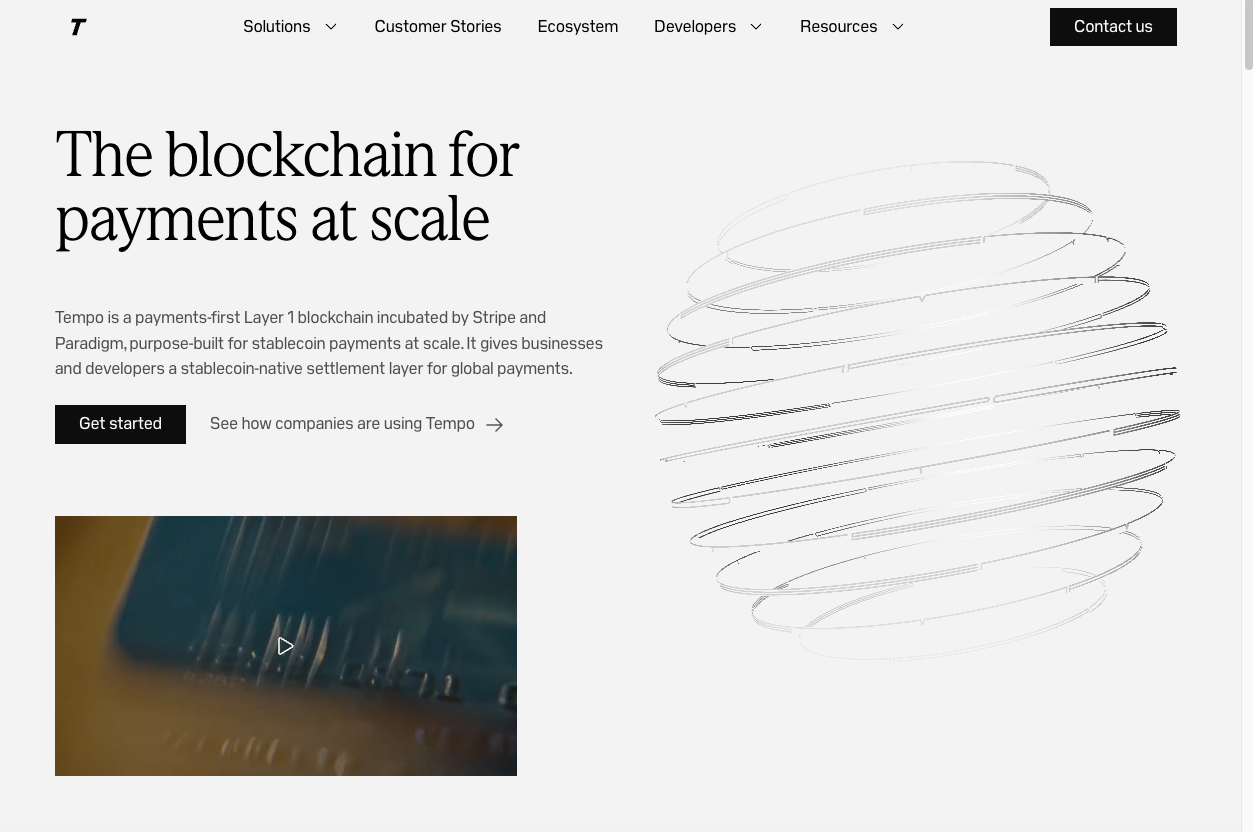
Tempo approaches the agentic economy from the payment rail outward. Rather than adapting a general-purpose blockchain to high-frequency stablecoin transfers, it is designed around predictable fees, reliable settlement, high throughput, and payment-specific transaction flows.
Tempo’s sessions support repeated or streaming payments rather than forcing a separate checkout interaction for every small unit of work.
That design fits the emerging machine transaction pattern well.
A research agent may buy one dataset, call several models, pay for browser or compute time, and compensate another agent within a single workflow. What looks like one task to a human can produce dozens or hundreds of small payments behind the scenes.
Predictable stablecoin-denominated costs and sub-second settlement are more important in that environment than a broad speculative-asset ecosystem.
Tempo remains newer and less battle-tested than Ethereum, Base, or Solana.
Turnkey offers first-class Tempo support across mainnet and the Moderato testnet. The Turnkey MPP integration also lets developers use a Turnkey-backed Viem signer as a drop-in account for Tempo payments.
6. NEAR: chain abstraction and privacy for agents
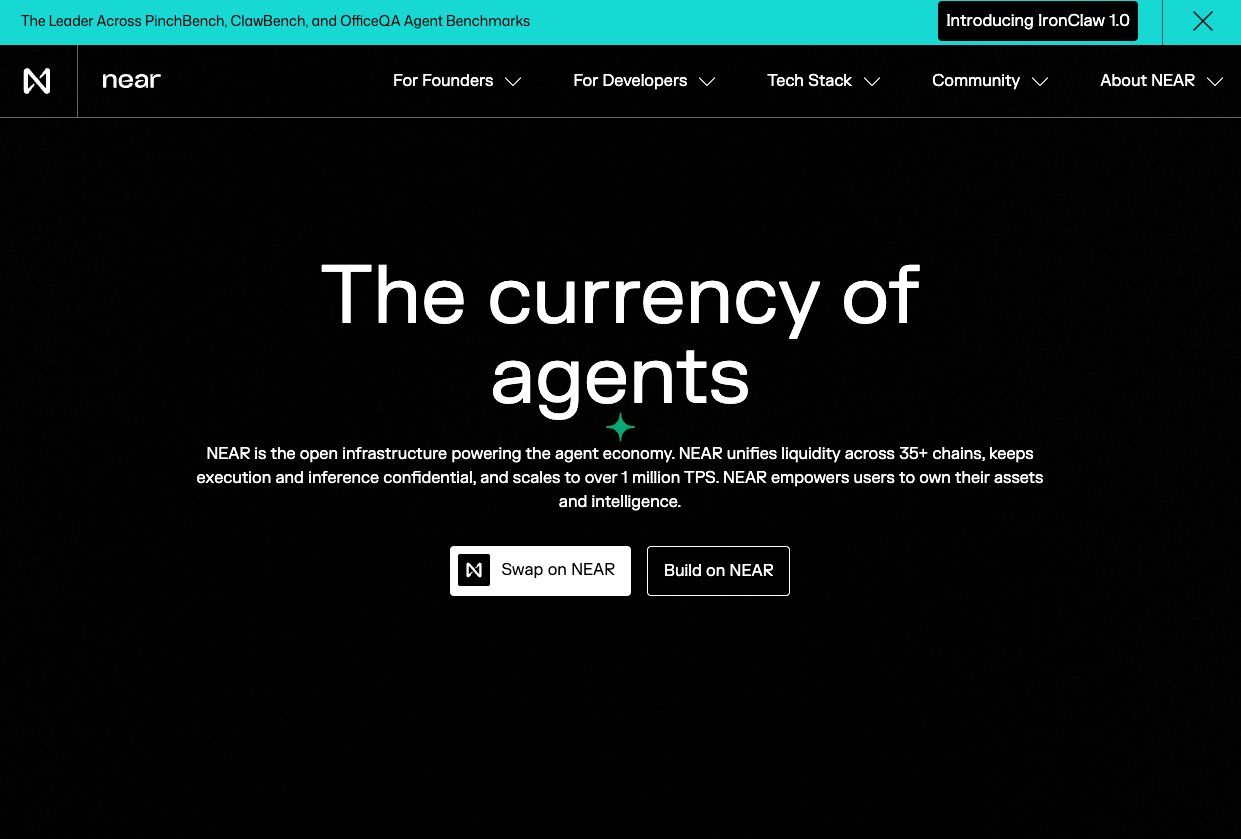
NEAR makes the most explicit general-purpose bet that agents will become the primary users of blockchain infrastructure.
NEAR Intents is central to that strategy. Instead of forcing an agent to understand bridges, gas tokens, routes, and transaction formats across every network, an agent expresses the outcome it wants. Competing solvers can then fulfill that intent across supported chains. As of August 2026, NEAR reports more than $24 billion in Intents volume across 35-plus chains.
That abstraction is valuable for agents because their goal is usually economic rather than chain-specific. An agent wants to acquire an asset, pay a service, or rebalance a portfolio, not manually orchestrate every bridge and swap required to get there.
Privacy is the second differentiator. Agents may handle personal information, proprietary strategies, prompts, or financial data that should not be broadcast on a transparent ledger. NEAR’s stack includes confidential execution and inference, with an aim to give agents access to onchain liquidity without exposing every part of their decision process.
Turnkey supports NEAR signing at the cryptographic-curve level. For NEAR, the value proposition is portable signing infrastructure that can support a compatible chain before a dedicated transaction integration exists.
Turnkey: One wallet layer across six different agent economies
These six chains are not interchangeable, and “best” depends on the workload.
Ethereum is the standards and high-value settlement layer. Base leads in x402-powered stablecoin payments. Solana is optimized for frequent, low-cost agent actions. Sui maps concurrent agents to an object-centric execution model. Tempo is purpose-built for machine payments. NEAR abstracts cross-chain execution and adds a privacy-oriented AI stack.
What they share is the need for controlled signing authority. An autonomous agent should have its own identity and wallet, but it should not have unlimited power. Its permissions should specify what it can sign, where funds can go, how much it can spend, which contracts or programs it can call, and when a human approval is required.
Because Turnkey is built around the cryptographic curves beneath these networks, a Turnkey-backed wallet layer can span all six. The depth of support varies by chain, but the security model remains consistent: keys stay isolated, policies are evaluated before signing, delegated access can be revoked, and gas sponsorship can remove native-token friction where supported.
Explore Turnkey’s infrastructure for AI agents to build autonomous systems that can transact across the agentic economy without giving up control.
And get started with Turnkey today.


.png)
.png)