.png)
Some of the most innovative early examples of using AI with digital finance are coming out of the crypto trading sector. From copy bots to AI “wingmen”, algorithmic trading is getting a fresh makeover with thinking agents at the helm.
Onchain trading specifically offers a unique environment for AI, with its 24/7 open markets and the ability to give AI restricted access to digital wallets. Already in 2026, a growing number of applications are using AI to research markets, monitor positions, manage portfolios, and execute trades on behalf of users.
Consider the following:
- The onchain AI agent token sector is worth about $3.16 billion, according to CoinGecko's AI Agents category.
- The broader market for AI-related crypto tokens sits around $21.5 billion, per CoinGecko's Artificial Intelligence category.
- In 2025, 40 cents of every venture capital dollar invested in crypto went to companies also building AI, up from 18 cents the year before, according to Silicon Valley Bank's 2026 crypto outlook.
Some of the types of trading that innovative applications are using AI for include: market research, copy trading, portfolio management, risk monitoring, automated execution, yield optimization, and natural-language trading.
And the chains vary too. These applications are being built across Ethereum, Solana, Base, Arbitrum, BNB Chain, and other onchain ecosystems, depending on the markets, liquidity, and trading experiences they support.
Here are 6 applications using the power of AI to make their customers' trading experiences faster, more efficient, and better positioned.
1. Spectral (SYNTAX)
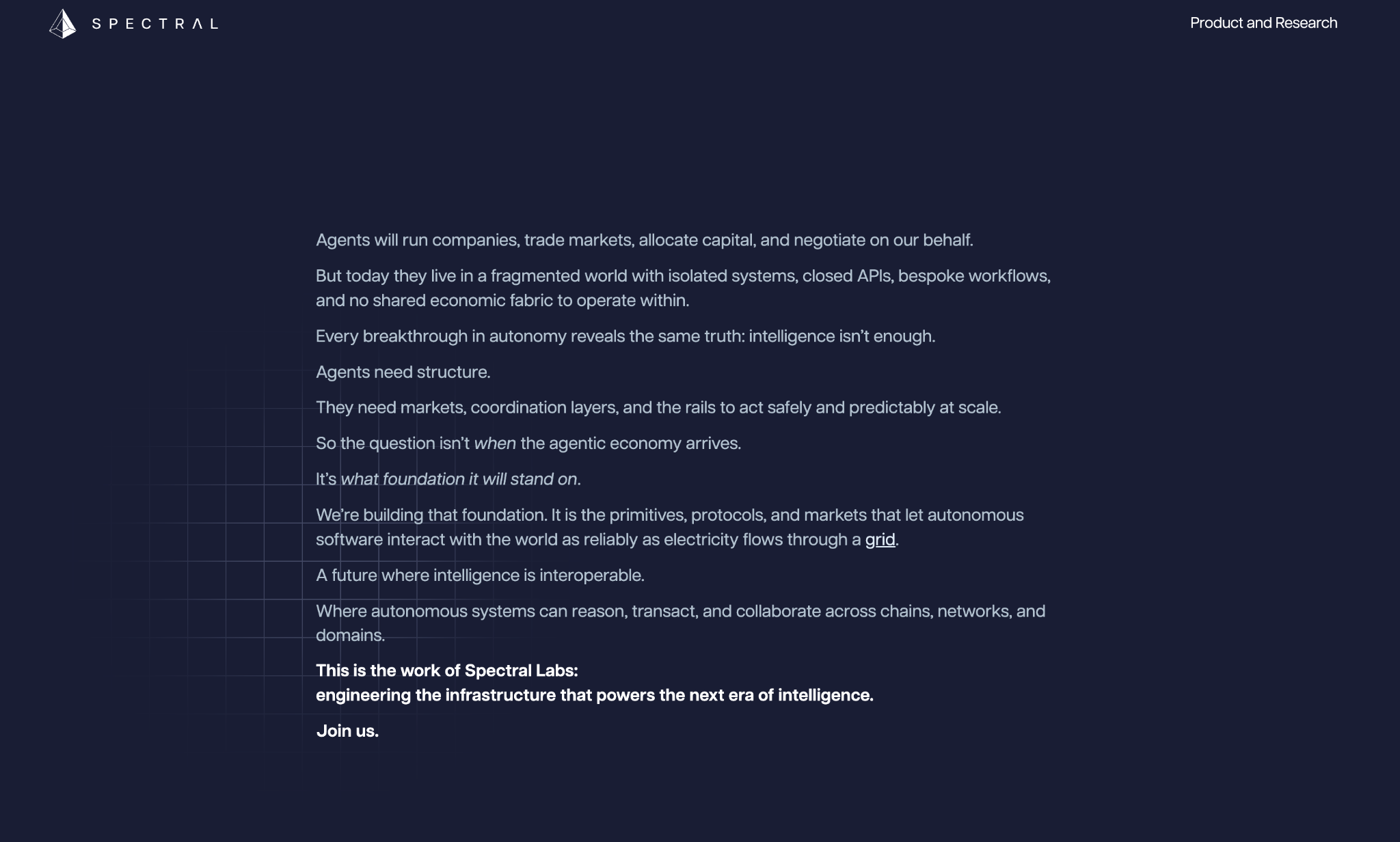
Spectral runs autonomous onchain AI agents through its SYNTAX product, letting an agent research markets and execute trades without a person approving each step. The hard part of shipping an agent like this is authority: give it too little and it cannot act, give it too much and a single bad decision can drain a wallet. Spectral solves that by giving every agent its own smart wallet on Turnkey, with the policy engine checking transaction amounts and signature patterns before anything reaches the chain.
What's innovative: Instead of trusting the agent's judgment, Spectral bounds it at the infrastructure layer. Each agent gets real authority to act and a set of limits it cannot cross, so autonomy and safety stop being a trade-off. That per-agent wallet model also means one misbehaving agent is contained rather than a risk to the whole system.
How they're using AI: The AI is the trader, not the assistant. Agents take in market data, decide on a strategy, and execute onchain on their own, while the policy engine acts as the guardrail on every signature.
2. andMilo
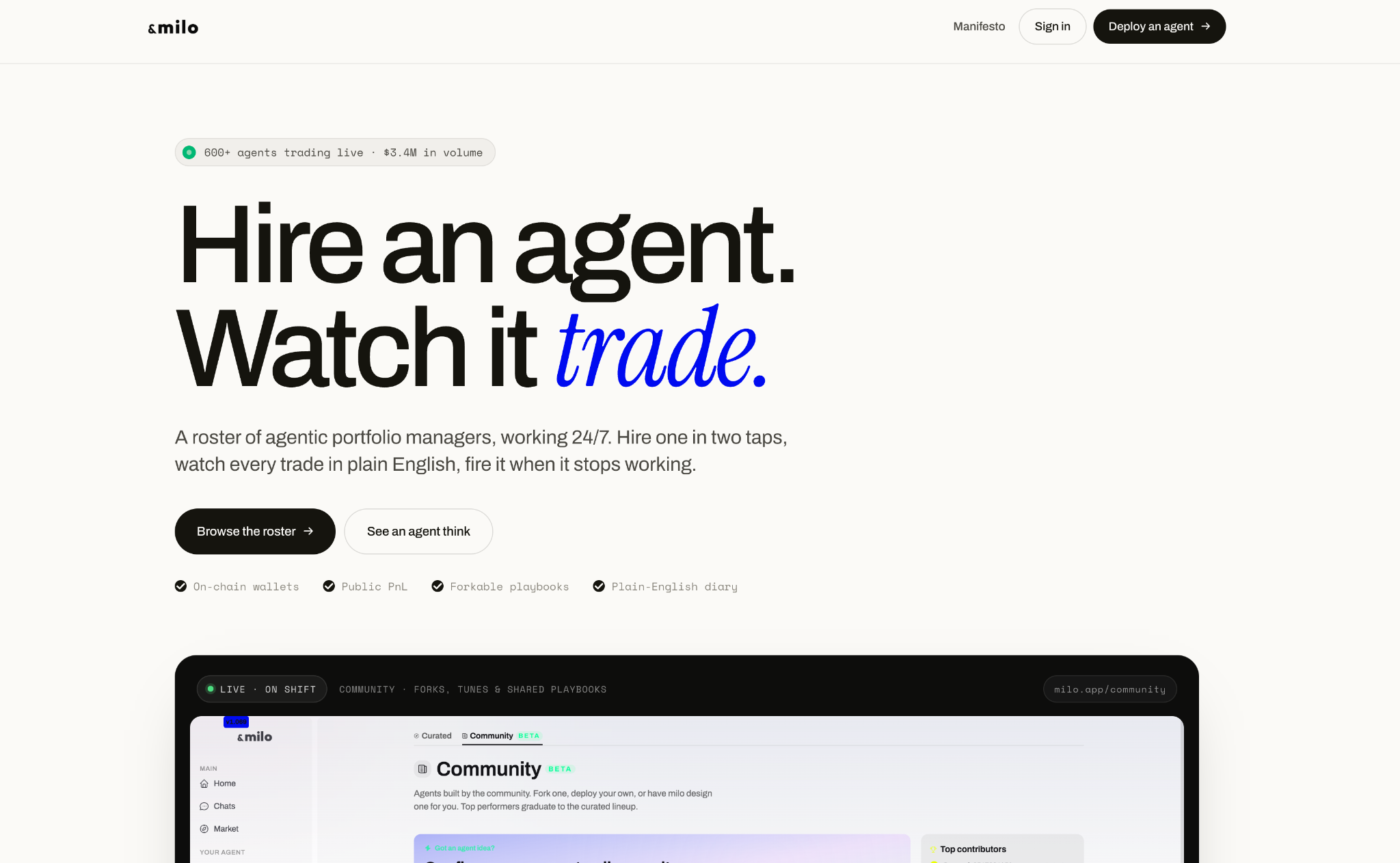
andMilo lets users pick from a roster of AI trading agents, fund one, and watch it trade around the clock on Solana. Each agent works from its own self-custodial wallet and keeps a plain-English diary of what it is doing and why. That diary turns an otherwise opaque strategy into something a user can actually follow, which lowers the trust barrier for handing money to software.
What's innovative: The "hire an agent and watch it work" model makes autonomous trading approachable, and the plain-English diary is the standout detail. It answers the question every user of an AI trader eventually asks, which is not just what did it do but why.
How they're using AI: Each agent is an autonomous trader running its own strategy continuously, executing from a self-custodial wallet so the user holds the keys while the agent does the work.
3. Velvet Capital
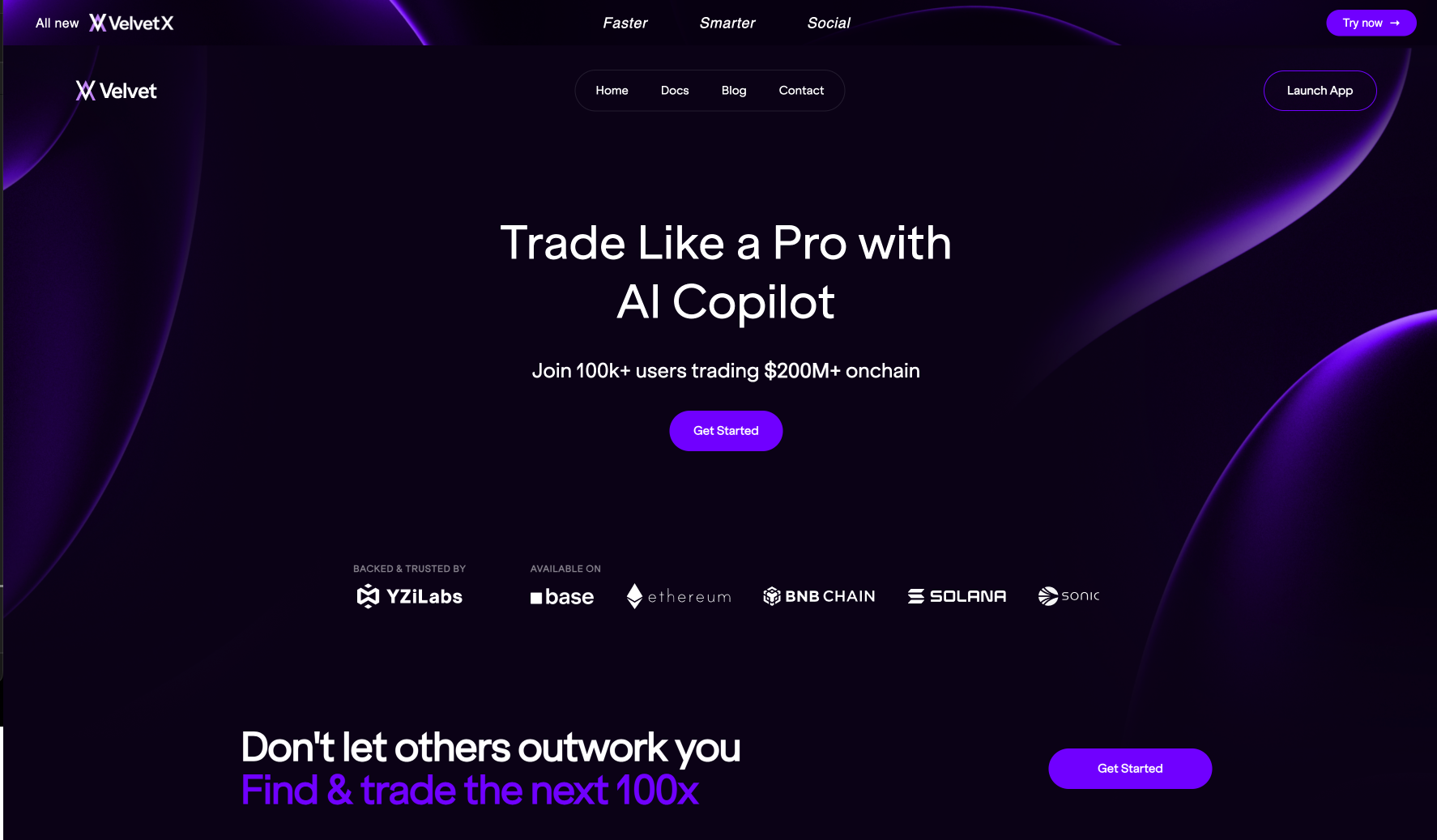
Velvet Capital is an onchain trading terminal for spot and perpetuals with AI-powered routing and an AI copilot that helps users analyze markets and execute across several chains, including Base, Ethereum, BNB Chain, and Solana. The company reports more than 100,000 users and over $200 million traded onchain. Social and portfolio tools sit on top of the non-custodial trading core, so users can follow and copy others without giving up custody.
What's innovative: Velvet pairs an AI copilot with multichain execution in one non-custodial surface, so the intelligence and the trade live in the same place. The social and portfolio layer then extends that from a solo tool into something closer to a shared trading network.
How they're using AI: A copilot helps users read the market and shape trades, while AI-powered routing works under the hood to find execution paths across chains. The AI assists the decision and optimizes the fill.
4. DuckAI (Ducky Capital)
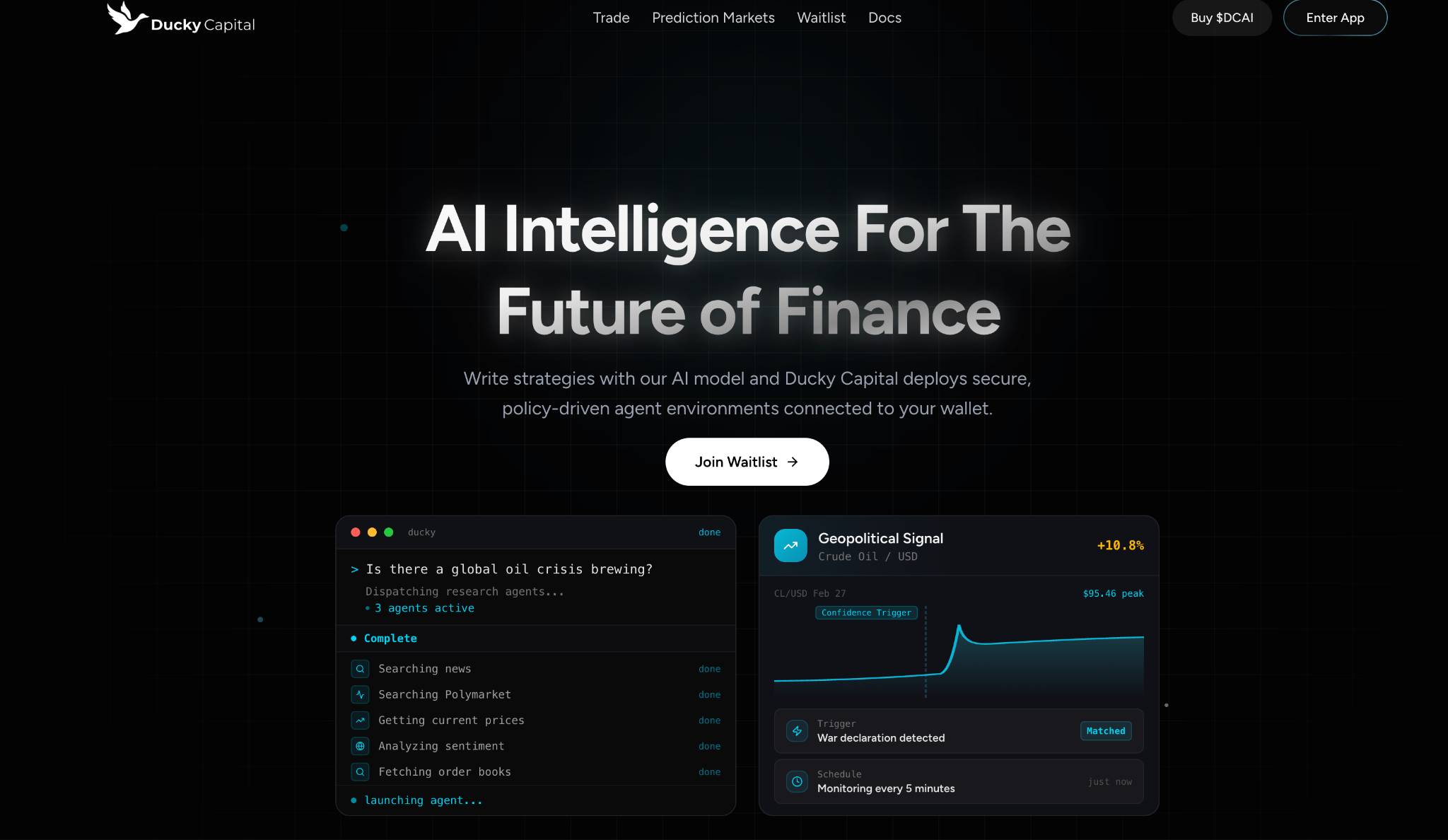
DuckAI, the product from Ducky Capital, lets users write trading strategies in plain language and hands them to an AI model that spins up policy-driven agent environments connected to the user's wallet. Those agents run delta-neutral trades, perpetuals, prediction markets, and yield strategies, with a policy gate checking each transaction before it executes.
What's innovative: DuckAI collapses the gap between describing a strategy and deploying it. A user writes the idea, and the system stands up a bounded agent to run it, so strategy authoring becomes the interface rather than code or a bot configuration screen.
How they're using AI: An AI model translates a plain-language strategy into a running agent, then operates it across perpetuals, prediction markets, and yield venues. The policy gate on each transaction keeps the agent inside the limits the user set.
5. o1.exchange (Cohuman)
o1.exchange, from Cohuman Labs, is a self-custodial trading terminal on Base and Solana that uses AI for trend detection and smart order routing. It works as a meta aggregator, pulling spot, perpetuals through Hyperliquid, and prediction markets into a single interface, with anti-MEV protection on execution. The team's engineering roots are squarely in AI agents, which shows in how the terminal is built.
What's innovative: o1 folds market intelligence and execution into one self-custodial terminal, then aggregates across venue types that traders usually juggle in separate apps. The AI layer is aimed at giving retail users an informational edge that normally sits with quant desks.
How they're using AI: Models analyze onchain data, social sentiment, and liquidity to detect trends and surface signals, and smart order routing uses that analysis to find the best execution path across integrated protocols.
6. Donut (Donut AI)
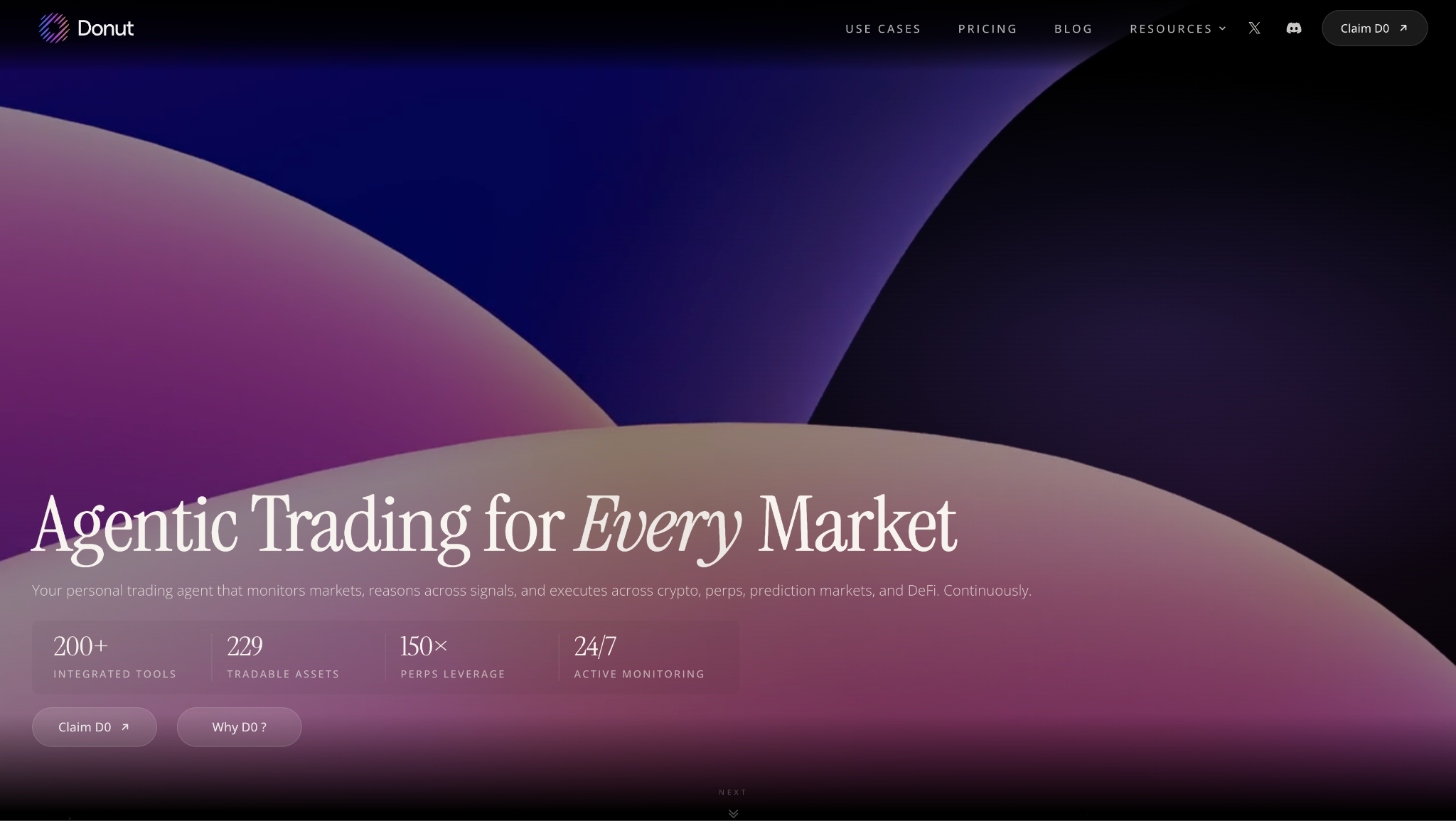
Donut is an agentic trading browser whose AI agent monitors markets, reasons across signals, and executes across crypto, perpetuals, prediction markets, and DeFi, continuously and in plain language. It runs on an alert, analyze, execute, and control loop, so a user can hand off routine decisions and keep the final say. Built on Solana and on Turnkey, Donut raised roughly $22 million in its first six months and drew a waitlist of more than 160,000 users.
What's innovative: Donut puts the agent where the user already is, which is the browser. By making the browsing layer itself the execution environment, it turns reading about a token into acting on it, without switching to a separate trading app.
How they're using AI: An in-domain crypto model and a swarm of browser agents watch markets, interpret signals, and execute onchain, running continuously rather than waiting for a manual command. The alert, analyze, execute, and control loop keeps a human in charge of the boundaries.
What’s included in Turnkey’s wallet infrastructure for AI trading
An AI that can suggest or execute a trade is useful, but agents need wallets they can operate within clear constraints. For all their usefulness, agents without boundaries could execute an inaccurate trade or use funds beyond their intended scope, causing unnecessary loss.
This is the core problem agentic wallets solve. Rather than handing an agent a private key, the agent gets a scoped credential, and the enclave only produces a signature after checking the request against policy. That distinction is what separates a wallet an agent can safely operate from one that just happens to be programmatically accessible.
For AI trading specifically, that means:
- Contract and function-level scoping — policies can restrict signing to specific contracts so an agent executing trades can't wander outside approved DEX interactions.
- Spending limits and thresholds — caps on trade size, with consensus rules that require both the agent and a human approver above a set threshold.
- Multi-chain coverage — a single agent identity can carry chain-specific policies across EVM and SVM, so the same trading logic can operate on multiple networks without separate credential setups.
- Instant revocation — deleting the agent's user permanently and immediately cuts off all access, useful if a strategy misbehaves or needs to be pulled fast.
The same policy model extends to agentic payments more broadly, covering things like destination allowlists, sponsored gas so agents don't need to hold native tokens, and webhook-based monitoring so an agent (or the team overseeing it) can react to transaction outcomes without polling.
Security for autonomous execution
Private keys are the credentials that allow a user access to their funds onchain. With Turnkey, private keys are generated and used inside secure enclaves and are never exposed to the agent or application code. Policies are enforced within the same protected environment, so application-level access cannot bypass the rules governing a wallet.
This gives trading applications a secure way to grant agents real authority without handing them unrestricted access to user funds.
Speed built for trading
Turnkey’s enclave-based signing executes transactions in sub-100 milliseconds, helping applications respond quickly as prices and liquidity move.
For latency-sensitive trading experiences, Turnkey also supports 0ms client-side signing, which creates transaction signatures directly on the user’s device to remove network round trips and enable near-instant execution.
Session-based signing can further reduce repeated approvals across multistep strategies, allowing traders and agents to move efficiently while remaining within the boundaries set by the user.
Reliability for 24/7 markets
Crypto markets never close, and autonomous agents may need to monitor positions and execute continuously.
Turnkey provides 99.9% uptime, giving trading applications reliable signing infrastructure for operating around the clock, even as transaction volume and market activity increase.
Multichain by default
Turnkey supports hundreds of blockchain networks, giving trading applications one infrastructure layer for wallets, policies, and signing across ecosystems including Ethereum, Solana, Base, Arbitrum, BNB Chain, and more.
For AI trading applications, that means agents can move quickly, operate continuously, and execute across chains while users remain non-custodial and in control.
Turnkey: Wallet infrastructure built for trading and AI
AI is already changing how users research markets, discover opportunities, manage portfolios, and execute trades across Solana, Ethereum, Base, and other onchain ecosystems. The applications covered here show several possible models, from AI copilots and natural-language terminals to fully autonomous agents running strategies around the clock.
But the more authority an application gives an agent, the more important its wallet infrastructure becomes. AI trading applications need fast and reliable signing, strong private key security, multichain support, and enforceable policies that define exactly what an agent can do.
Turnkey gives developers the infrastructure to build those experiences while keeping users non-custodial and in control. Agents can execute quickly and continuously, but only within the boundaries their users establish.
Start building your AI trading application with Turnkey today.


.png)
.png)